A prediction is more useful when it reports how much confidence to place in it. Uncertainty quantification measures and represents uncertainty about predictions or unknown quantities, rather than returning only a single value. Probability distributions make this uncertainty visible: a prediction can include a mean together with a 95% credible interval. section 3.15
Predicting house prices
A probabilistic linear regression model predicts house prices from a feature such as size. Its posterior predictive distribution combines observed data with prior beliefs, producing both likely prices and uncertainty intervals. Wider or narrower intervals show how risky individual predictions may be, which matters because many price-affecting factors are difficult to measure. section 3.15
Predictive uncertainty can arise from different sources and be estimated with several approaches:
- Aleatoric uncertainty comes from inherent noise in the data. section 10.9
- Epistemic uncertainty comes from limited knowledge about model parameters. section 10.9
- Bayesian neural networks place distributions over weights and biases, while MCMC and variational inference approximate their otherwise intractable posteriors. section 10.9
- Monte Carlo dropout keeps dropout active during prediction and uses repeated forward passes as samples from an approximate predictive distribution. section 10.9
Figure 3.6 The posterior predictive distribution of individual datapoints in the test set, illustrated by the predictive mean and 95% credible intervals. Most datapoints in the training set falls within the credible intervals.
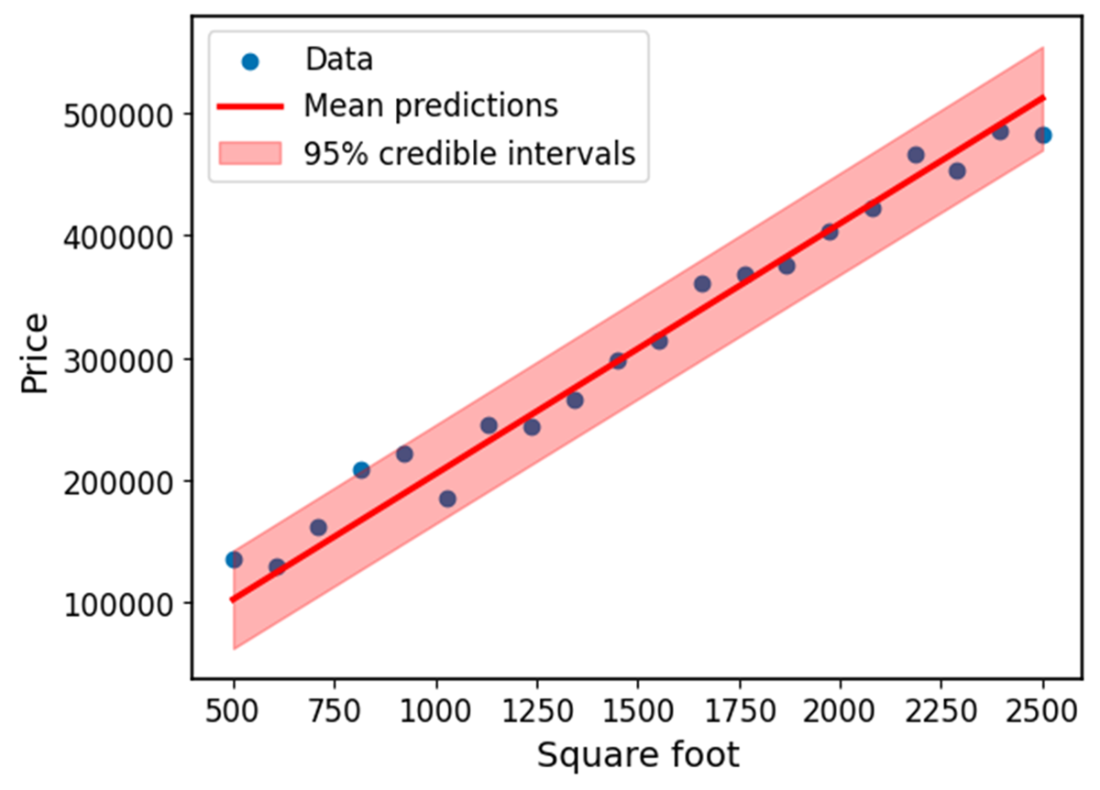
Visualize predictive means and 95% credible intervals for individual house-price predictions. section 3.15

