An undirected graph represents relationships without direction: if node A connects to node B, B also connects to A. Nodes are also called vertices, and edges are also called links. section 1.2.1
An adjacency matrix stores every connection in one table. For an undirected graph, the matrix is symmetric across its diagonal because each edge appears in both directions. section 1.2.1
Use the matrix entries to distinguish common graph properties:
- Store 1 for an unweighted edge and 0 for no edge. section 1.2.1
- Store a larger value when one relationship has greater weight than another. section 1.2.1
- Inspect the diagonal to identify self-loops: zero means no connection from a node to itself, while a nonzero value adds one. section 1.2.1
- Represent the same relationships with adjacency lists, edge lists, or an incidence matrix instead of an adjacency matrix. section 1.2.1
Sensor and referral networks
A sensor network can use a constant, unweighted undirected adjacency matrix connecting 31 sensor positions across time. A staffing network can treat candidates as nodes and referrals as undirected, unweighted edges by ignoring referral direction and repeat referrals. section 6.2.1 section 8.1.1
Table 1.1 The adjacency matrix for the simple graph in figure 1.1
|
A
|
B
|
C
|
D
|
E
|
|
|---|---|---|---|---|---|
|
A
|
0
|
1
|
0
|
0
|
1
|
|
B
|
1
|
0
|
1
|
1
|
1
|
|
C
|
0
|
1
|
0
|
1
|
0
|
|
D
|
0
|
1
|
1
|
0
|
1
|
|
E
|
1
|
1
|
0
|
1
|
0
|
Use the adjacency matrix to inspect the symmetric connections of a simple five-node graph. section 1.2.1
Figure 6.5 Sensor networks showing the error of wrongly inferring graph structures. The nodes are human skeletal connections. The left figure shows a network with edges inferred from node proximity (closest nodes connected to one another). This figure does not reflect a real human skeleton. The true set of edges is shown in the right figure.
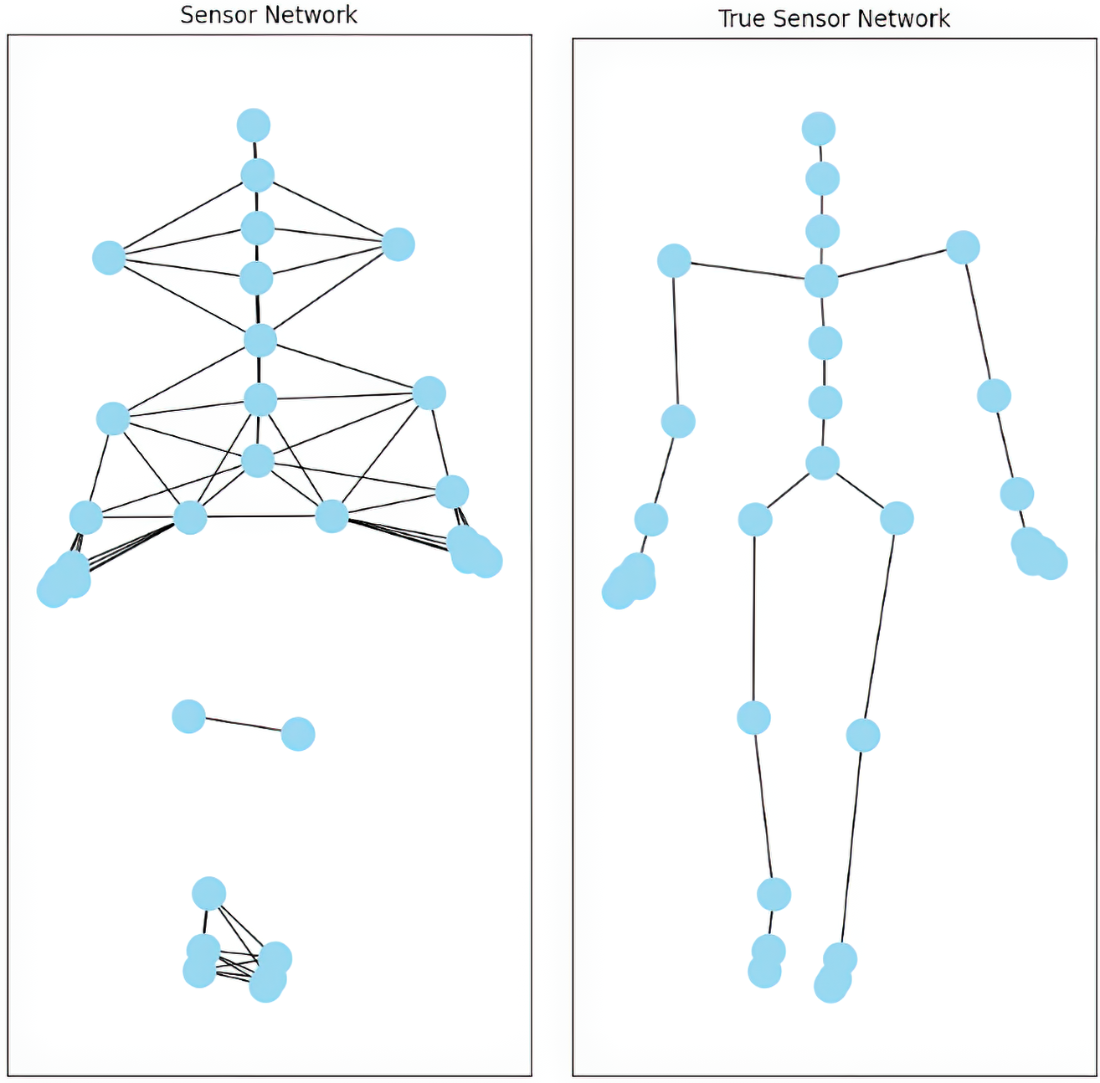
Compare an incorrectly inferred sensor network with the true skeletal connections to see why graph structure must reflect the real relationships. section 6.2.1




