Computers store letters as numbers, not as meaningful shapes. Unicode gives characters from the world’s writing systems numeric code points and defines how they may combine, while leaving their visible glyphs to typeface designers. section 3.0 section 3.5
Unicode’s design balances broad coverage with older conventions:
- It aims to encode more than 100,000 characters, with over 1 million available slots for future use. section 3.5
- It preserves ASCII assignments: hexadecimal 0041 represents A, matching ASCII’s decimal 65. section 3.5
- It supports both precomposed accented letters and separate combining marks, because historical systems adopted both approaches. section 3.5
- It represents writing systems whose parts combine spatially, such as Thai consonants and vowels arranged around one another. section 3.5
A character is not its printed shape
The number assigned to A identifies the character; a typeface determines whether that character appears in a serif, sans-serif, bold, or other visual form. This separation lets encoding and typography perform different jobs. section 3.5 section 3.7
Figure 3.11 The Thai alphabet
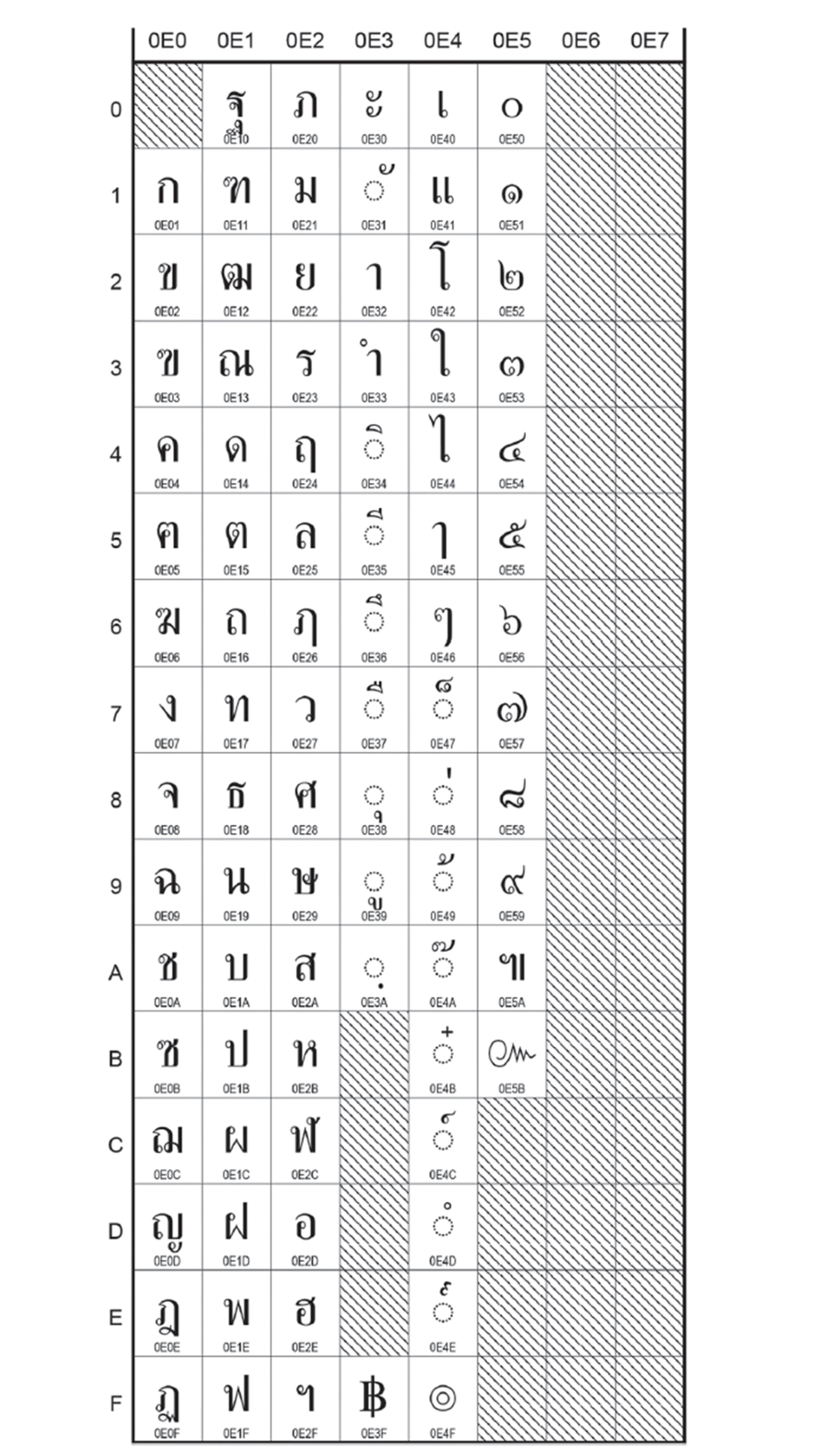
Use the Thai alphabet table to see how Unicode accounts for characters whose vowels occupy positions around consonants. section 3.5







