An out-of-vocabulary word is text that a tokenizer cannot represent using its available tokens, even by combining known subwords. The tokenizer may emit an unknown token, commonly written as [UNK]. section 2.2.2 section 2.2.3
This is a tokenizer failure, not evidence that the model understands a new word imperfectly. If the text cannot be represented, the model cannot capture information from that piece of text. Larger vocabularies reduce this risk but increase model size, so token design balances coverage against efficiency. section 2.2.2
A word outside the vocabulary
Suppose an unusual word is absent from the vocabulary and no available subword sequence can represent it. The tokenizer emits [UNK], replacing the original symbol with a generic marker and losing information about that text. section 2.2.2 section 2.2.3
Figure 2.3 The normalization process commonly involves changing text to remove uppercase characters and punctuation.
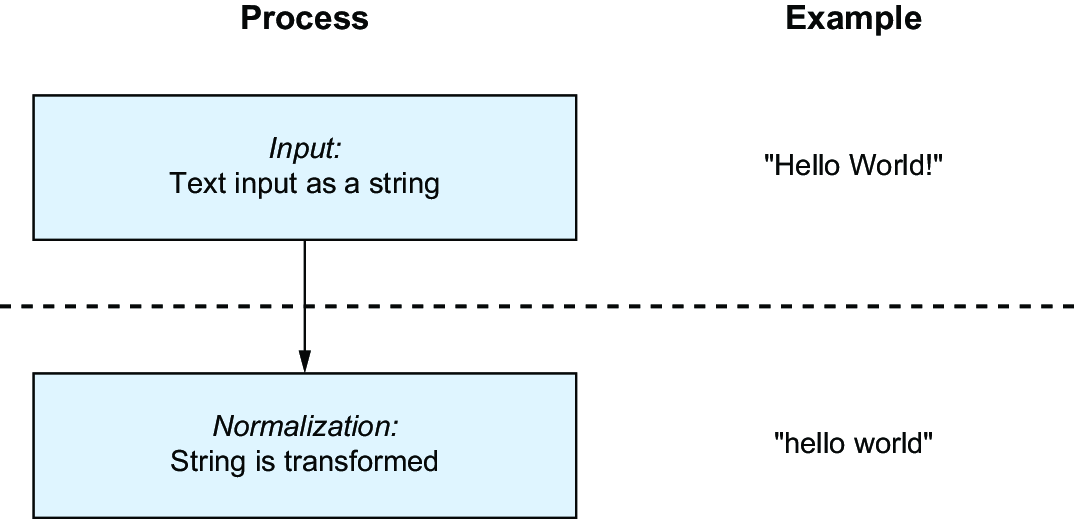
Normalization can reduce out-of-vocabulary pressure by mapping variants such as “LLMs,” “LLms,” and “llms” to one simpler form, though it may also remove distinctions. section 2.2.2







