Unlabeled data contains no label identifying the target value or category to predict. Whether a feature counts as a label depends on the problem: an email dataset may be unlabeled if no column matters for the question being asked. section 2.6 section 2.5
Pet images without tags
A dataset containing only cat and dog images is unlabeled when it does not say which animal appears in each image. A model cannot directly predict cat or dog labels, but it can compare images and group similar ones, perhaps separating animals or breeds. section 2.10 section 2.6
Unlabeled data supports several kinds of analysis:
- Clustering groups similar data points into clusters. section 2.10
- Dimensionality reduction simplifies data with fewer features while preserving much of its information. section 2.10 section 2.17
- Generative learning creates new data points resembling the existing dataset. section 2.10
Figure 2.1 Labeled data is data that comes with a tag, or label. That label can be a type or a number. Unlabeled data is data that comes with no tag. The dataset on the left is labeled, and the label is the type of pet (dog/cat). The dataset in the middle is also labeled, and the label is the weight of the pet (in pounds). The dataset on the right is unlabeled.
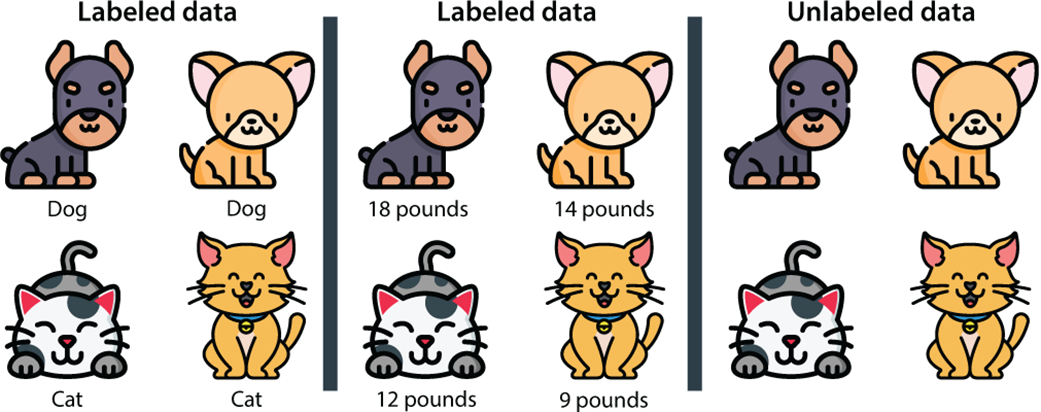
Compare labeled pet datasets with an image-only dataset to see how the presence or absence of a target changes the learning task. section 2.6
Figure 2.4 An unsupervised learning algorithm can still extract information from data. For example, it can group similar elements together.
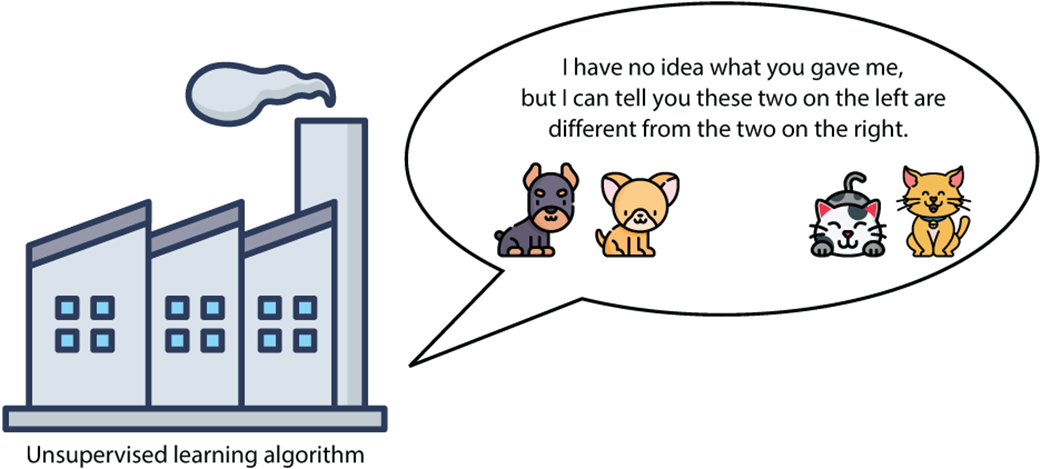
See how an unsupervised method can extract structure by grouping similar unlabeled images. section 2.10





