Unsloth
Unsloth is an open-source software library that accelerates language-model training and fine-tuning while reducing memory and other resource requirements.
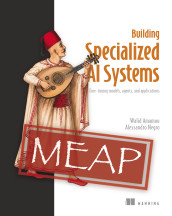
Building Specialized AI Systems
An open-source library for accelerating and simplifying large-language-model fine-tuning.
- How it is used
- Accelerates domain-specific fine-tuning when compute resources are limited.
- How deep it goes
- Demonstrates installation, model loading, LoRA configuration, dataset formatting, training, testing, and saving, while deferring detailed parameter explanations.
- Examples
- Uses a credit-risk dataset, chat prompt template, applicant test case, and generated high-risk assessment.
- What you can do after
- Operate a LoRA fine-tuning workflow for a quantized language model and save the resulting model and tokenizer.
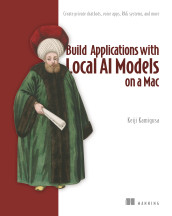
Build Applications with Local AI Models on a Mac
A software library that accelerates and streamlines fine-tuning of language models while aiming to reduce memory use.
- How it is used
- Uses Unsloth to connect fine-tuning on personal examples with local model deployment.
- How deep it goes
- Outlines training, export, and deployment steps with example commands, without detailing the notebook training cells.
- Examples
- Uses conversations, documents, and input/output pairs as training data and shows GGUF export and Ollama commands.
- What you can do after
- Apply it via Unsloth to fine-tune a selected model on domain data and export it for local serving.
Read how Build Applications with Local AI Models on a Mac explains Unsloth →
Also covered in
- LLM Customization and Fine-TuningIn early access (MEAP)
- Domain-Specific Small Language Models
What to know first
- language modelA language model is a computational model that represents patterns in linguistic sequences to assign probabilities, predict, generate, or evaluate language.
- LlamaLlama is a family of large language models developed by Meta.
- low-rank adaptationLow-rank adaptation (LoRA) is a parameter-efficient fine-tuning technique that adapts a model by learning low-rank updates to its weights, typically while keeping most original weights fixed.
- Proximal Policy OptimizationProximal Policy Optimization is a policy-gradient reinforcement-learning algorithm that limits policy updates to keep successive policies close and promote stable learning.
Related concepts
- Tritonuses · Triton is a programming language and compiler for writing and compiling high-performance GPU kernels.
- low-rank adaptationuses · Low-rank adaptation (LoRA) is a parameter-efficient fine-tuning technique that adapts a model by learning low-rank updates to its weights, typically while keeping most original weights fixed.
- fine-tuningimplements · Fine-tuning is the continued training of a pretrained model on targeted data or objectives to adapt its parameters or behavior to a task, domain, or use.
- GGUFproduces · GGUF is a binary file format for storing machine-learning model tensors and associated metadata, designed to support efficient model loading and inference.
- Google Colabuses · Google Colab is a hosted Jupyter notebook service that provides browser-based interactive coding environments with access to cloud computing resources.
- Ollamacontrasts with · Ollama is software for downloading, managing, running, and serving language models locally.
Questions about Unsloth
What is Unsloth?
Unsloth is an open-source software library that accelerates language-model training and fine-tuning while reducing memory and other resource requirements.
Which Manning books explain Unsloth?
Building Specialized AI Systems and Build Applications with Local AI Models on a Mac.
What should I know before learning Unsloth?
Manning books that teach Unsloth usually introduce language model, Llama, low-rank adaptation and Proximal Policy Optimization first.
What is the difference between Unsloth and Ollama?
Unsloth is an open-source software library that accelerates language-model training and fine-tuning while reducing memory and other resource requirements. Ollama is software for downloading, managing, running, and serving language models locally.
These guides are generated from the text of Manning books by Manning's knowledge graph and link to the sections they draw on. The full books are available on liveBook and at manning.com.