The update rule is the final stage of message passing. It replaces or revises each node’s or edge’s features with a representation that includes the newly computed message, combining local data with information from the graph. section 3.4.2 section 1.5.3
Treat one message-passing layer as a short pipeline:
- Aggregate information from each node’s neighborhood using an order-invariant operation such as sum, mean, or max. section 3.4.2
- Transform the aggregated messages with a neural network to produce new embeddings or features. section 3.4.2 section 1.5.3
- Update each node or edge by incorporating that transformed message into its stored features. section 3.4.2
Completing the update finishes one round of message passing. Stacking layers repeats the process, allowing representations to encode information from progressively more hops away in the graph. section 3.4.2 section 1.5.3
Figure 3.15 Elements of our message-passing layer. Each message-passing layer consists of an aggregation, a transformation, and an update step.
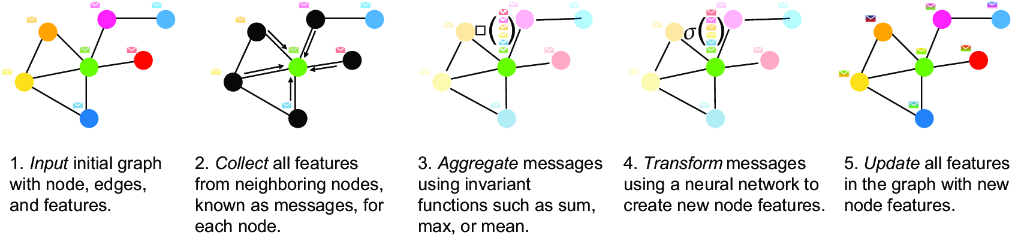
Use the message-passing diagram to track the update rule as the third stage after aggregation and transformation. section 3.4.2
