Upsampling increases a feature map’s spatial resolution. In a decoder, it enlarges compressed 4×4 maps to 8×8 maps so the network can reconstruct image details. section 12.19
Two common approaches illustrate the trade-off:
- Nearest-neighbor interpolation duplicates each pixel into a 2×2 area, providing a fast, straightforward way to double resolution. section 12.19
- Transposed convolution applies learned filters to each input pixel, painting larger patches whose overlapping values are added together. section 12.19
From 4×4 to 8×8
Imagine giving a small feature map to an artist. Interpolation copies its marks, while a transposed convolution learns brushstrokes that add coherent detail. A U-Net decoder can then produce sixteen 8×8 feature maps. section 12.19
Figure 12.40 Simplistic upsampling with nearest neighbor interpolation
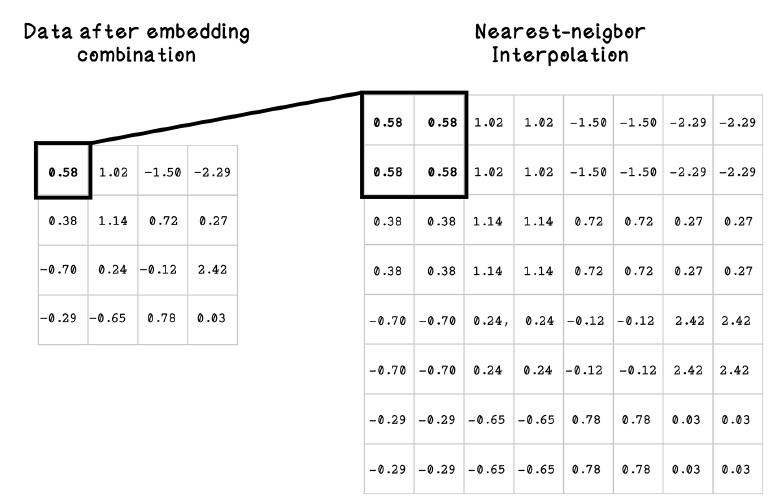
Use the nearest-neighbor visualization to see how each small-map pixel expands into a 2×2 region. section 12.19



