Intention is the actionable expression of purpose for a specific change. It connects why a change matters to what should be built, giving implementation, design, and verification a shared target. An intuition that account security needs improvement, an idea to add password reset, and an objective to improve security are not yet precise enough to direct that change. section 1.1.2 section 1.1.3
Password reset for account recovery
“Build a password reset flow” names a feature but leaves a consequential decision unstated. If the purpose is to recover a potentially compromised account, changing the password hash alone is insufficient. State that purpose in the request; then require the design to invalidate active sessions and the tests to verify their termination. The user experience can also confirm that the account has been secured. An agent can satisfy every stated requirement and still miss this outcome when the purpose remains implicit. section 1.1.1 section 1.1.2
Figure 1.2 We begin with intuitions indicating that users are struggling with compromised accounts. Our purpose, which is to help them regain access, focuses these observations, guides us toward approaches that address the issue, and helps us articulate an intent that defines the desired outcome and its success criteria. This intent seeds the context and acts as a filter, selecting relevant details such as the session store design and security policy while excluding unrelated information such as the payments module. This context-construction process gives the agent just enough information to achieve the intended outcome rather than flooding it with everything available.
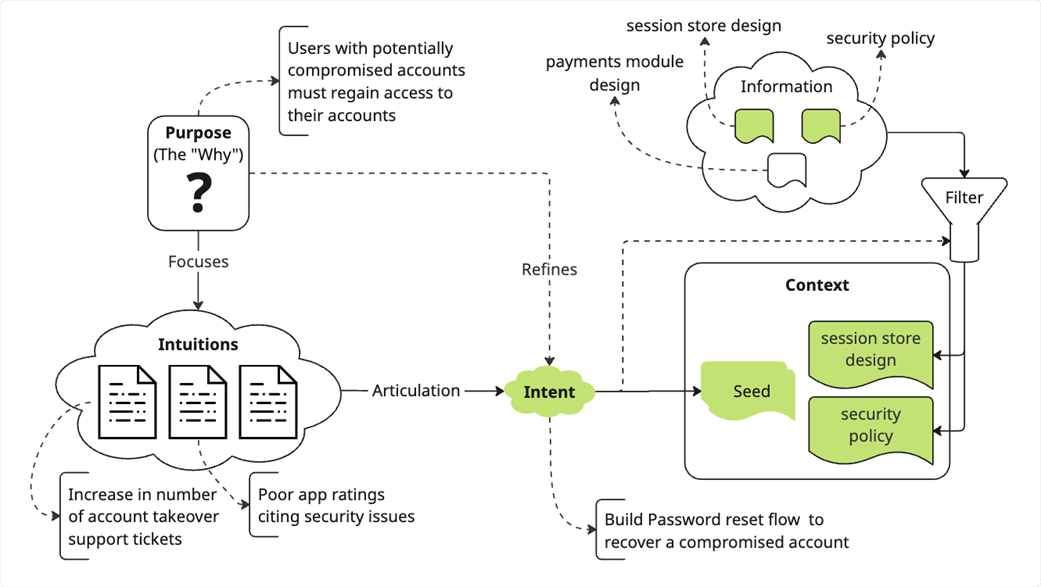
The diagram traces how a purpose becomes an intended outcome and success criteria, then filters which context the agent needs, such as session-store design rather than unrelated modules. section 1.1.2
Intention is not the whole context; it determines which other information matters. Capture it in specifications and tests so that a change does not depend on a conversation, an agent’s inference, or the current implementation. If a Windows log-cleanup script must be replaced for Linux, returning to the original requirement—delete old logs only when a corresponding archive exists—avoids reconstructing that rule from platform-specific code. section 1.1.3 section 1.1
Keep the intended target usable as work changes:
- Match the specification to the change: a small feature may need behavior and acceptance criteria; an architectural change may also need constraints, migration notes, risks, rollout steps, and decisions. section 2.5.4
- When implementation exposes a gap, repair the specification before relying on a direct code fix. If gaps recur, examine whether intention was lost while surfacing, capturing, constructing, or verifying the change, and improve that part of the workflow. section 3.4 section 3.7