A user survey is a structured data-collection instrument that gathers responses to predefined questions. In practice, it can provide evidence about how software developers use AI tools, but its usefulness depends on understanding how questions became columns and values. section 6.2 section 6.2.2
A practical survey-analysis workflow starts by:
- Reading the original survey to identify relevant questions and understand response options. section 6.2.2
- Using a data dictionary to map questions such as professional coding experience to answer columns such as YearsCodePro. section 6.2.2
- Inspecting shape, sample rows, missing values, and column representations before transforming the data. section 6.4.1
- Accounting for categorical text, semicolon-separated multiple-choice responses, ordinal Likert answers, and unanswered questions. section 6.4.1
Developer attitudes toward AI tools
A dataset containing about 89,000 responses can compare current use, intended future use, interest, trust, and favorability toward AI tools with age, experience, and job title. Because many questions are optional, inspect missingness and distinguish genuinely unanswered questions from rows containing almost no response data. section 6.2 section 6.4.1
Figure 6.5 An excerpt of the mapping document used as a data dictionary
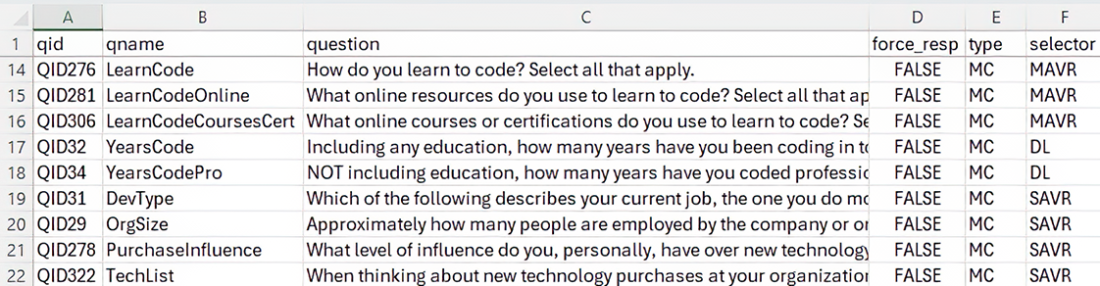
Use the mapping document to navigate from survey questions to the columns that encode their answers. section 6.2.2





