liveBook · Manning

Validation window

As explained in Time Series Forecasting Using Foundation Models

A validation window is a contiguous held-out time period on which a forecast is generated during cross-validation.

A validation window is a contiguous held-out time period used to generate forecasts during time-series cross-validation. Each window tests a fixed forecast horizon against subsequently observed actual values. section 3.6

Use successive windows to approximate repeated forecasting in practice:

  • Choose a forecast horizon and number of windows. section 3.6
  • Generate forecasts, then update the input with the actual values from that window. section 3.6
  • Compare predictions with actuals across windows using metrics such as MAE and sMAPE. section 6.3.2
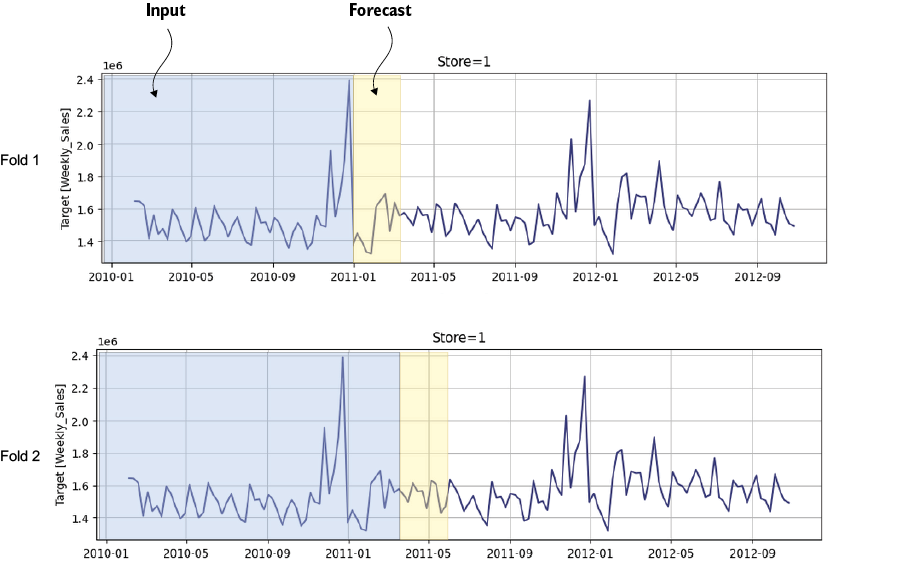
Figure 3.14 Illustrating the behavior of cross-validation with TimeGPT. A fold designates one round of cross-validation. By default, nonoverlapping windows are used.
A graph of a graph showing a store and store

Description automatically generated with medium confidence

A diagram shows each fold as a fixed-horizon forecast and distinguishes the successive nonoverlapping validation windows. section 3.6

How Time Series Forecasting Using Foundation Models covers it

How deep it goes
Explains sequential updates, fixed horizons, nonoverlap, fold counts, and metric evaluation, but does not develop the underlying forecasting models.
Examples
Uses Walmart weekly sales with four eight-week windows, producing 32 test points for model comparison.
What you can do after
Evaluate forecast performance across repeated test periods using MAE and sMAPE.
How it connects
Connects cross-validation with forecast horizon, folds, MAE, sMAPE, and model evaluation.

Related concepts

This explainer was generated by Manning's knowledge graph from the text of Time Series Forecasting Using Foundation Models. The section links point to the parts of the book it draws on.