A song near the top of a streaming service’s list may be easy to choose, but popularity does not prove it is valuable to you. Value is the subjective benefit a user attributes to recommended content, and there is no agreed way to measure it directly. section 1.3.3
Since platforms cannot directly measure value, they use behavioral signals such as engagement as proxies. That proxy can mislead: clickbait may attract attention, and prominent popular songs can become still more popular simply because they are easy to find. Recommenders also infer preferences from interactions, but known interests may crowd out undiscovered ones. Balancing familiar recommendations with new ones is an exploration-versus-exploitation dilemma, and users differ in how much discovery they welcome. section 1.3.3 section 4.2
Figure 4.1 Recommender systems learn our preferences by observing our interactions with the items they present. There is no guarantee that all the preferences will be appropriately accounted for. In this figure, the user is a book lover, but the system is unaware of their preferences, and it’s reinforcing the known ones.
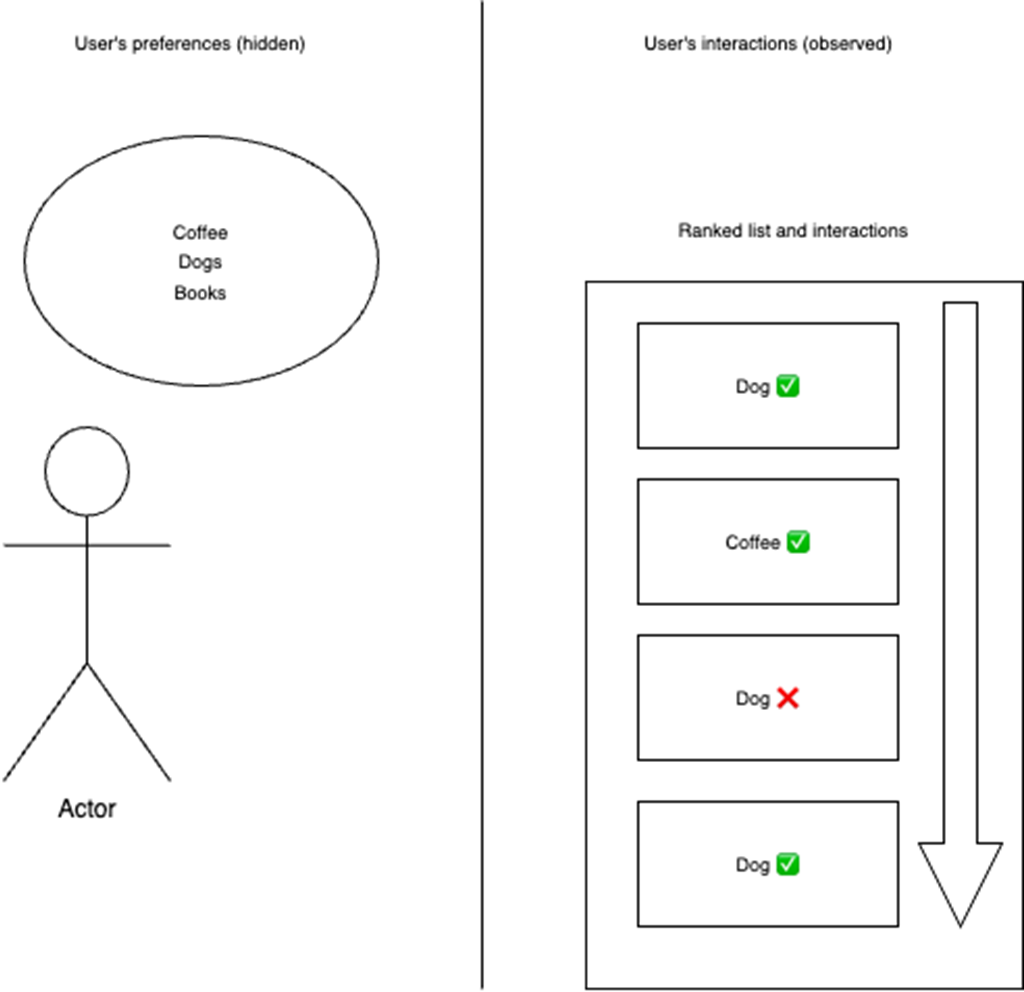
The figure illustrates how a recommender can reinforce known preferences while missing another interest, such as a user’s love of books. section 4.2

