Vector normalization is the operation or property of making a vector have length one. In a basis, normalized vectors provide a consistent unit scale; when they are also perpendicular, the basis is orthonormal. A basis need not be normalized or orthogonal when another coordinate system is more useful. section 2.1.2
For a curve, direction and length solve different problems. Partial-derivative ratios determine a tangent line, while derivative magnitudes determine tangent-vector length. Choosing normalized, pixel-proportional tangents prevents oversized handles from distorting an otherwise smooth contour. section 12.4.4
Taming a contour
The tangent vectors (dx, dy) = (1, 2) and (2, 4) point along the same tangent line, but the latter is twice as long. Normalizing the tangent vectors keeps the curve smooth while removing unwanted loops caused by disproportionate lengths. section 12.4.4
Figure 12.22 Exaggerated tangent vectors spoil the contour. It’s still technically smooth and continuous, though.
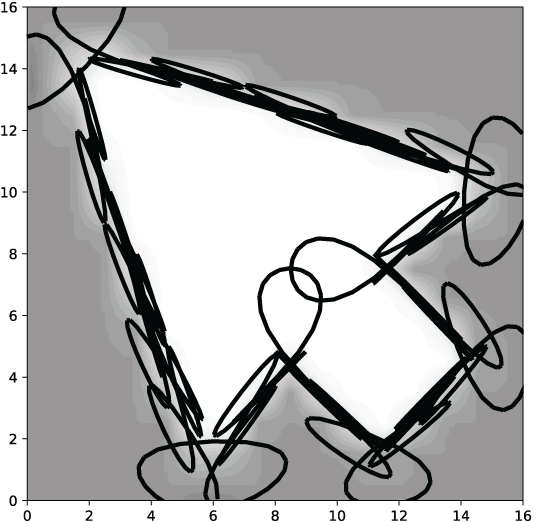
Compare an exaggerated tangent construction with its normalized counterpart to see why direction alone does not guarantee a well-shaped contour. section 12.4.4
Figure 12.23 By normalizing tangent vectors, we keep the contour smooth, but the unwanted loops are gone.
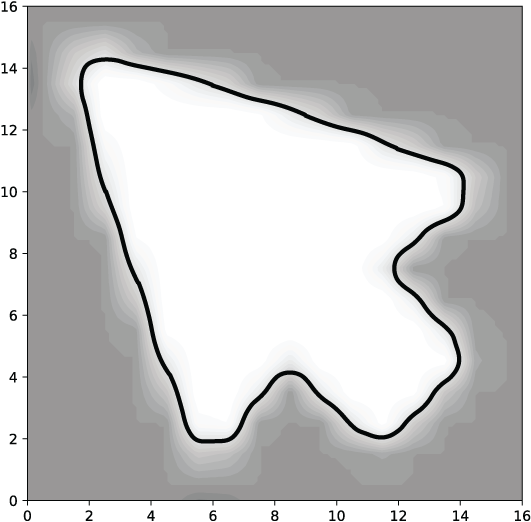
Use the normalized-contour figure to see how unit-length-aware tangents preserve smoothness and remove unwanted loops. section 12.4.4
