A vector space represents language as points in a high-dimensional geometric space rather than as atomic strings. Words or passages with related meanings occupy nearby regions, allowing semantic metrics to recognize similarity beyond exact word overlap. section 3.2.3
Use the geometric model to interpret semantic comparison:
- Treat lexical matching as checking whether words occupy identical coordinates. section 3.2.3
- Treat semantic matching as measuring distance between vector representations. section 3.2.3
- Expect contextual embeddings to assign different locations to the same word in different contexts. section 3.2.3
- Compare orientation when vector magnitude reflects length or frequency more than semantic content. section 3.2.3
Meaning without shared words
“The attorney filed the brief” and “the lawyer submitted the document” can occupy nearby regions despite sharing no words, because their vector representations capture related meaning. section 3.2.3
Figure 3.6 Geometric representation of two semantic vectors. Note that while the vectors have different lengths (magnitudes), they point in roughly the same direction, indicating a shared semantic topic.
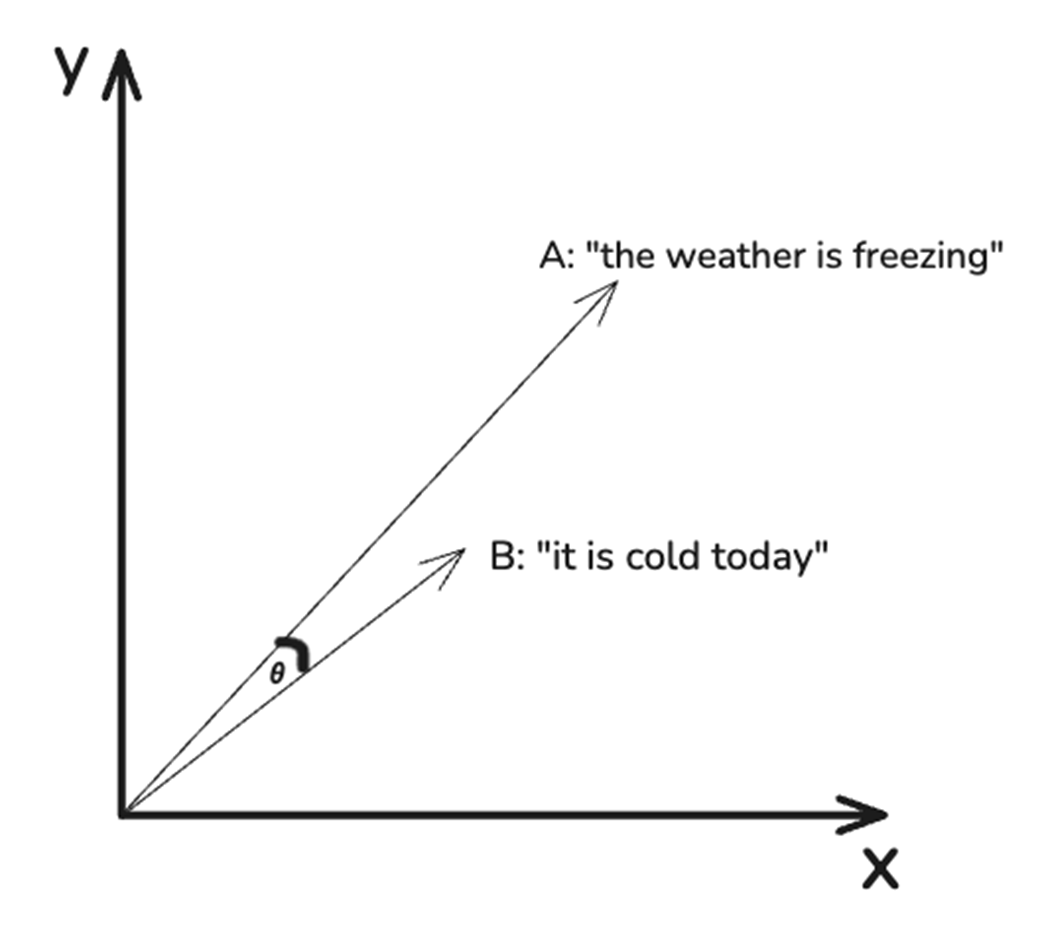
Use the geometric representation to see how vectors with different magnitudes can still point in similar directions and indicate a shared semantic topic. section 3.2.3





