Vector products combine vectors to support practical geometric work. The dot product produces a scalar, the cross product produces a vector, and the triple product produces a scalar from three vectors. section 9.0 section 9.1
Their value becomes clearer through geometry: vector products encode angles, projections, areas, and volumes. Understanding that geometry helps turn standard operations into custom algorithms rather than merely calling utility functions. section 9.0 section 9.1
The three main products serve different geometric purposes:
- Dot product: combines two vectors into a scalar and supports geometric measurements such as angles and projections. section 9.0 section 9.1
- Cross product: combines two vectors into a vector; its length represents a parallelogram area in the triangle-distance construction. section 9.1 section 10.1.3
- Triple product: combines three vectors into a scalar whose magnitude represents parallelepiped volume and whose sign can encode sidedness. section 9.0 section 10.1.3
Triangle-mesh distance
For a point p and triangle points p1, p2, and p3, the triple product of (p3-p1), (p2-p1), and (p-p1) gives a signed parallelepiped volume. Dividing by the base area—the length of a cross product—gives the point’s signed distance to the triangle’s plane. If the projection falls outside the triangle, cross-product area calculations provide distances to its edges. section 10.1.3
Figure 10.4 The height of the parallelepiped h is the distance from point p to the plane that p1, p2, and p3 make.
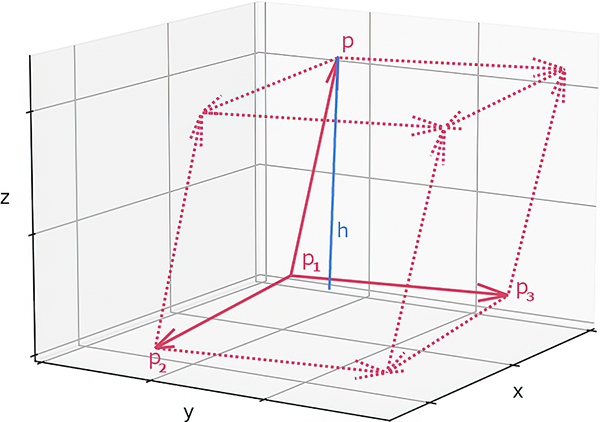
Use the parallelepiped-height figure to connect signed triple-product volume with distance from a point to a triangle’s plane. section 10.1.3

