In particle swarm optimization, velocity is a particle’s vector describing the direction and magnitude of its movement through the search space. It determines how far and which way the particle moves during an update. section 7.4 section 7.8
Velocity combines three influences:
- Inertia preserves some of the particle’s current motion; high inertia encourages exploration, while low inertia supports exploitation near good solutions. section 7.8
- The cognitive component pulls the particle toward its own best-known position. section 7.8
- The social component pulls the particle toward the swarm’s best-known position. section 7.8
The algorithm adds these influences to calculate a new velocity, then adds that velocity to the current position. Repeating this process lets particles explore different regions while converging toward promising solutions. section 7.8
A particle takes its next step
A particle at position (-1, 9) receives velocity 1.52. Its new position becomes (0.52, 10.52), illustrating how velocity translates a calculated movement into a position update. A firefly analogy captures the initialization intuition: small random starting velocities make particles scatter immediately instead of waiting for a leader. section 7.6 section 7.8
Figure 7.23 Particle-velocity calculation walk-through
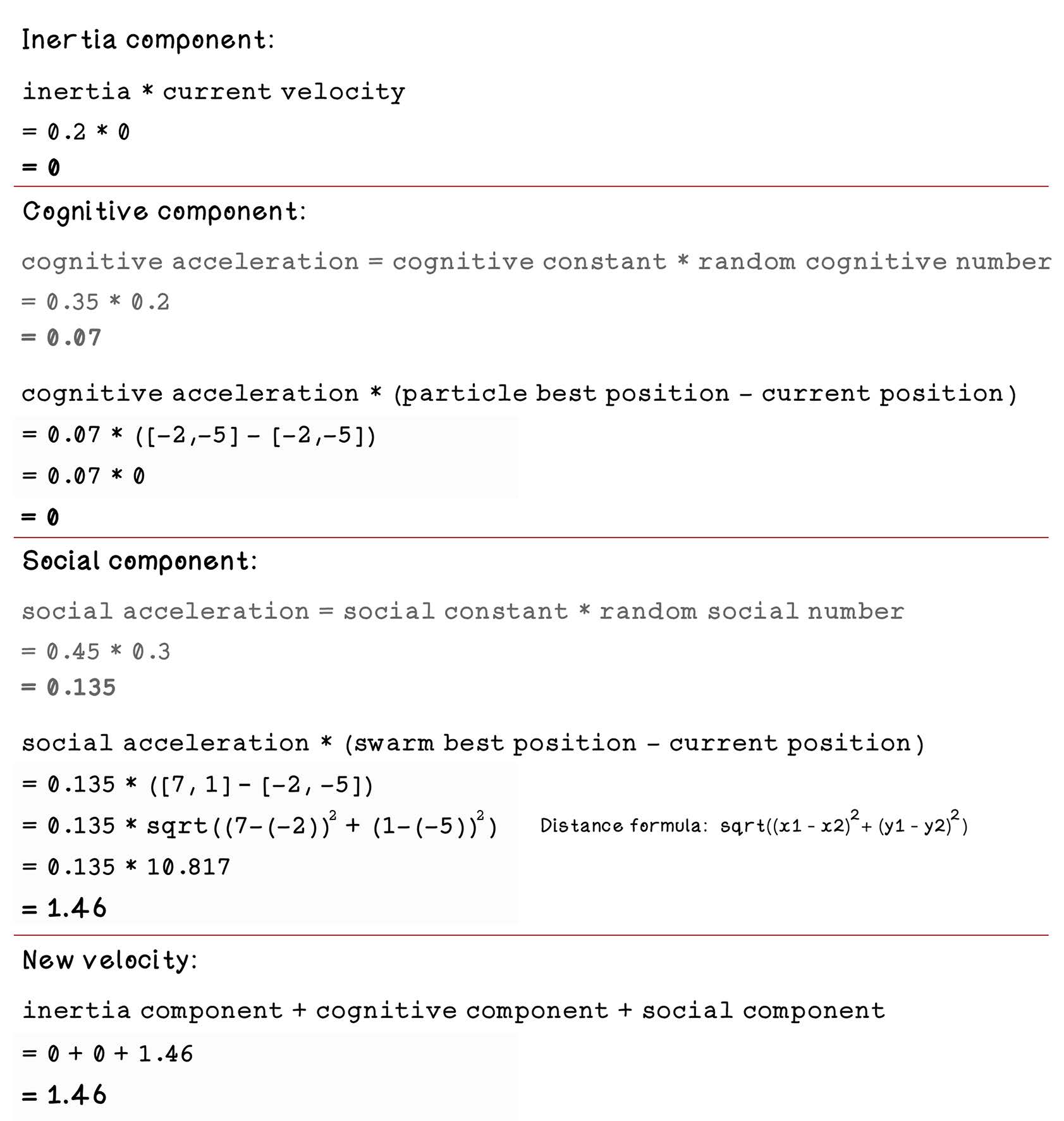
Use the particle-velocity calculation walk-through to trace how the component influences combine into a new velocity. section 7.8