Vibe coding moves from a high-level idea to generated code through instructions to a coding agent. When intent is not articulated in depth, the agent fills gaps from its training. A plausible result may match what you meant—or merely look as though it does. Misalignment is usually handled with another instruction after implementation, rather than by exposing assumptions beforehand. section 1.1.4 section 2.3.1
Figure 2.7 Mental model of vibe coding, where a lack of clear intent articulation in the instruction/prompt leaves room for interpretation mistakes, and alignment at best depends on the vibe.
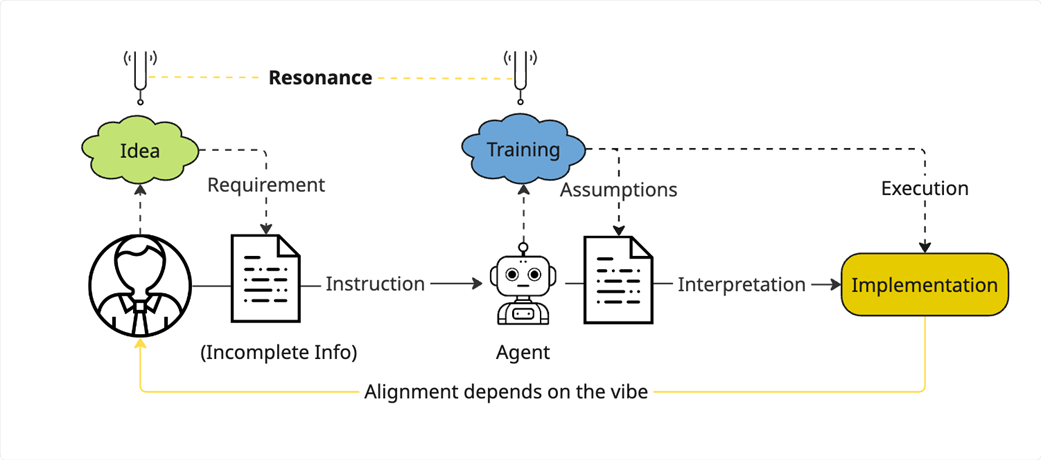
The diagram makes the central risk visible: an underspecified instruction leaves room for interpretation mistakes between the idea and its implementation. section 2.3.1
A URL shortener in one prompt
Ask an agent for an application that accepts a long URL, returns a short one, and redirects visitors to the original. One generated result supplies a Node HTTP server, in-memory storage, a form, and a redirect endpoint. It demonstrates how quickly a usable first pass can appear, but those implementation choices came from the agent’s interpretation, not a durable statement of intent. Subsequent instructions must correct any mismatch. section 2.3.1
That correction loop becomes costly as the application grows. The developer must repeatedly inspect, remember, and redirect the agent’s work; the agent cannot reliably execute a larger slice independently when unstated assumptions keep surfacing. Growing conversation history can also make each correction more expensive. Fast initial delivery therefore does not imply predictable delivery over time. section 2.3.3 section 2.3.4
Use the speed deliberately:
- For a prototype, proof of concept, or focused question, use the generated result to learn what is needed and what to leave out. section 1.6 section 2.4.1
- If the work is exploratory, be willing to discard its code. Close the spike once it has answered the question; do not treat its output as the product or its code as a tidied-up specification. section 2.4.1
- For sustained development, articulate intent in a specification that remains available to guide later features instead of rebuilding context through conversation. section 2.3 section 1.6