Autonomous action is an agent's ability to carry an implementation task forward without turn-by-turn human steering. It depends on durable intent and structured context, not simply a longer conversation: specifications and tests preserve decisions and provide verifiable completion criteria. section 1.3 section 2.3.3
Prepare an agent to act independently:
- Discover the user journey and clarify what a successful outcome requires. section 1.3
- Capture capabilities and constraints in durable specifications and tests, such as requiring active sessions to be invalidated after a password reset. section 1.3
- Assemble the remaining context around those artifacts so the agent has actionable information to execute and verify the implementation. section 1.3
Account recovery
For a potentially compromised account, clarify how the user resets a password and gains confidence the account is secure. A durable requirement to invalidate active sessions gives the agent a checkable outcome. By contrast, vibe coding leaves assumptions unstated, prompting repeated human corrections and preventing sustained independent work. section 1.3 section 2.3.3
Figure 1.3 A mental model of how IDD focuses on effective intent articulation to engineer context so that the agent can independently execute to deliver aligned outcomes.
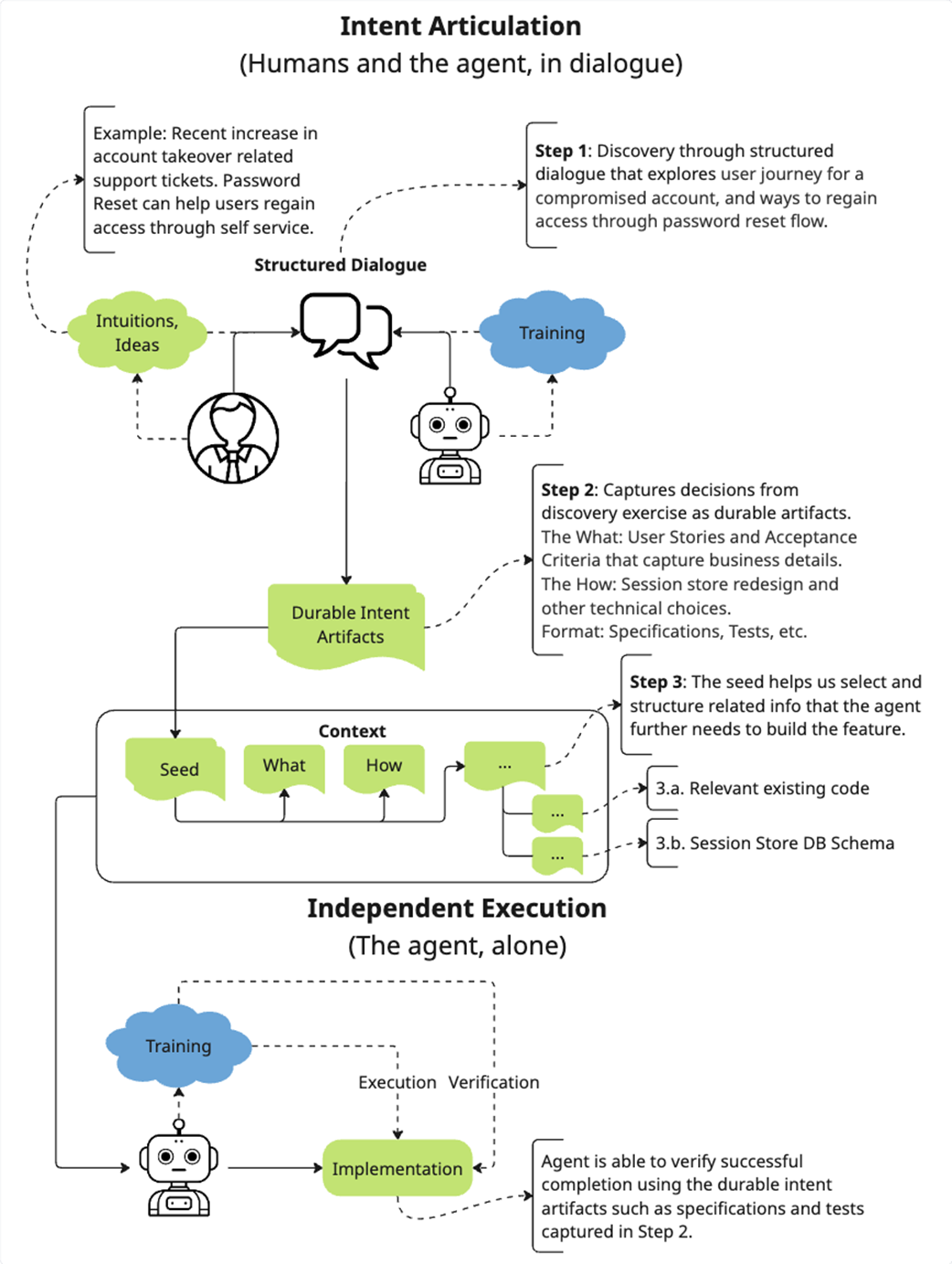
Shows the relationship between intent articulation, context, and independent agent execution. section 1.3