A virtual MAC address is a logical link-layer address shared by routers in a first hop redundancy protocol (FHRP). It represents the virtual default gateway rather than one physical router interface. section 19.1.2 section 19.4
When a host requests the virtual IP address (VIP) through ARP, the active router replies with the virtual MAC. The host then sends external traffic in frames addressed to that MAC, and switches learn it toward the active router. section 19.1.2
During redundancy and load-balancing scenarios:
- After failover, the new active router sends gratuitous ARP (GARP) messages sourced from the virtual MAC, updating switch MAC tables without changing hosts’ VIP or ARP entries. section 19.1.3
- HSRP uses group-based virtual MAC formats: 0000.0c07.acXX for HSRPv1 and 0000.0c9f.fXXX for HSRPv2. section 19.2.1
- VRRP uses 0000.5e00.01XX, while GLBP assigns each active virtual forwarder a unique virtual MAC to balance hosts within one subnet. section 19.2.2 section 19.2.3
Transparent FHRP failover
R1 serves as the active router and R2 as standby for VIP 10.0.0.1. If R1 fails, R2 takes over, sends GARP using the shared virtual MAC, and receives subsequent frames after switches relearn that MAC on R2’s port. section 19.1.3
Figure 19.4 An FHRP failover. (1) A hardware failure occurs on R1. (2) R2 takes over as the active router. (3) R2 sends GARP messages, sourced from the virtual MAC and destined for the broadcast MAC. (4) The switches learn the virtual MAC on the appropriate ports—those leading toward the new active router. (5) End hosts’ default gateways and ARP table entries for the VIP remain the same.
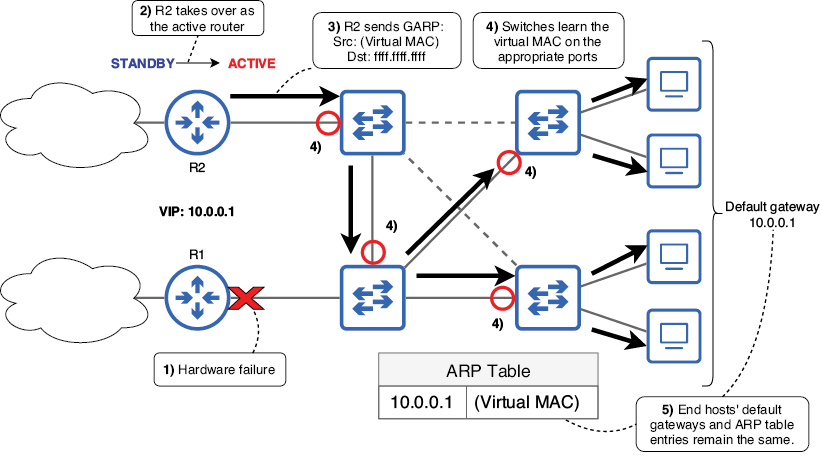
Trace the hardware failure, router takeover, GARP broadcast, switch relearning, and unchanged host gateway state. section 19.1.3
