Vulnerability means exposing uncertainty, disagreement, or personal views despite possible discomfort or social risk. In collaborative modeling, it helps make hidden tensions visible and invites others to share perspectives. section 4.3.4
A facilitator demonstrates vulnerability first, especially during a check-in or check-out. Sharing something personal can make others feel safer, while active listening and careful summaries help the group feel heard. section 5.4.3
Use vulnerability as a practical facilitation behavior:
- Answer the check-in question first with appropriate personal openness. section 5.4.3
- Stay quiet long enough for others to begin sharing, even when the pause feels uncomfortable. section 5.4.3
- Listen actively, cluster what people share, summarize major themes and notable examples, then ask what was missed. section 5.4.3
- Use the signals that emerge to improve the collaborative modeling session and decide whether to continue modeling or move to coding. section 4.3.4 section 5.4.3
Surfacing a hidden disagreement
A group becomes frustrated while creating a shared model because some participants are discussing a standard product and others a custom-made solution. A facilitator notices the polarity, introduces a sensemaking exercise, shares openly during the check-in, and creates room for minority perspectives to surface before the group decides its next step. section 4.3.4 section 5.4.3
Figure 4.10 Sensemaking exercise example using three options in a triangle. Using a pyramid offers several advantages: it captures nuanced opinions by providing a middle ground, reduces polarization by avoiding binary opposition, increases the accuracy of sensemaking collection by reflecting a wider range of perspectives, and enhances engagement by better matching individual views.
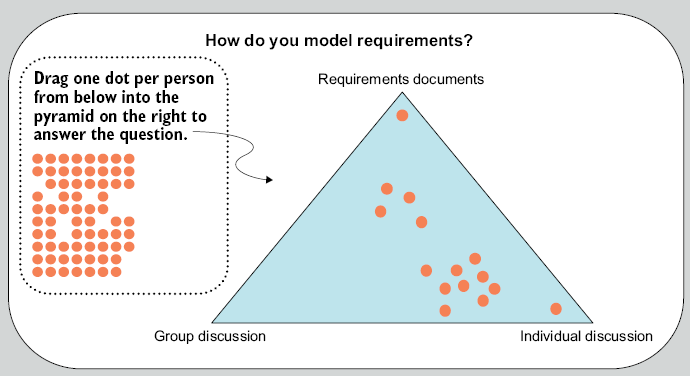
A triangle or pyramid-based sensemaking exercise gives vulnerable or uncertain viewpoints a middle ground, reducing pressure toward binary positions and making nuanced opinions easier to express. section 4.3.4

