liveBook · Manning

Prototype module

As explained in Infrastructure as Code, Patterns and Practices: With examples in Python and Terraform

A reusable infrastructure module that exports predefined configuration values or resources without necessarily creating infrastructure directly.

A prototype module accepts inputs and returns static defaults for other modules to consume. It usually exports configuration values rather than creating infrastructure directly. section 3.4

Apply the pattern when shared configuration must remain consistent and easy to evolve:

  • Collect common metadata or settings in one module instead of hardcoding them across resources. section 3.4
  • Pass the module’s returned copy into consuming resources, which can append or apply the predefined values. section 3.4
  • Use a prototype module for reusable repository checks when multiple module repositories must follow common formatting and linting standards. section 5.1.3
  • Update the prototype once, while recognizing that distributed repositories can still complicate dependency discovery and troubleshooting. section 5.1.3

Standard resource tags

A tagging prototype returns customer, business unit, cost center, and automated values. A database server consumes the returned tags, keeping metadata consistent without creating tag resources. section 3.4

Figure 3.7 A module with the prototype pattern returns a copy of static values, such as tags, for consumption by other infrastructure resources.
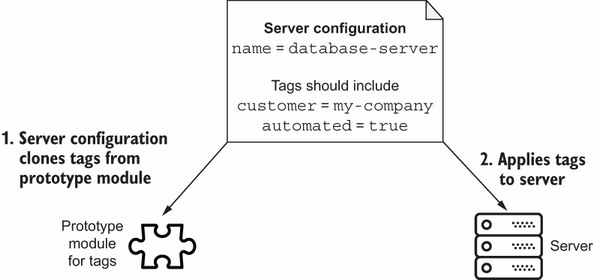
Shows the prototype module returning static values for consumption by infrastructure resources. section 3.4

How Infrastructure as Code, Patterns and Practices: With examples in Python and Terraform covers it

How deep it goes
Defines the pattern, demonstrates tag consumption, and addresses repository conformance, but does not detail implementation internals.
Examples
Uses standard resource tags, database-server configuration, and shared formatting and linting tests across module repositories.
What it assumes
Uses input variables, module references, and consuming resources; teaches the static-default pattern through tagging.
What you can do after
Build it from scratch to export shared defaults or checks and apply them consistently across resources or repositories.
How it connects
Connects prototype modules with infrastructure modules, configuration management, resource tagging, continuous integration, and repository structure.

Related concepts

This explainer was generated by Manning's knowledge graph from the text of Infrastructure as Code, Patterns and Practices: With examples in Python and Terraform. The section links point to the parts of the book it draws on.