A metadata and artifacts store is the system record for outputs produced across a deep learning workflow. It stores artifacts—especially trained models—and their metadata, preserving lineage that supports experimentation and troubleshooting. section 1.4
Services write training inputs and results into this shared store: hyperparameters, code versions, training metrics, and test results. A user interface can then compare experimental runs, while product managers can query system metrics. section 1.2.3
In a production flow, the store connects code, training, and serving through a common handle:
- Register packaged training and inference code containers under the same handle so services can locate matching code. section 10.2.3
- Let the training service retrieve the training container, then save the trained model with its handle and metadata. section 10.2.4
- Let the model service query for the matching inference container and model file when an inference request arrives. section 10.2.5
Visual-recognition deployment
A visual_recognition handle identifies registered training and inference containers. Training uses the handle to find code and stores the resulting model; serving uses it to retrieve the model and inference container for a request. section 10.2.3 section 10.2.4 section 10.2.5
Figure 10.7 A typical production model training setup. The workflow service manages what, when, and how training flows are run. The training service runs model training jobs. The metadata and artifacts store provides training code, stores trained models, and associates them with metadata.
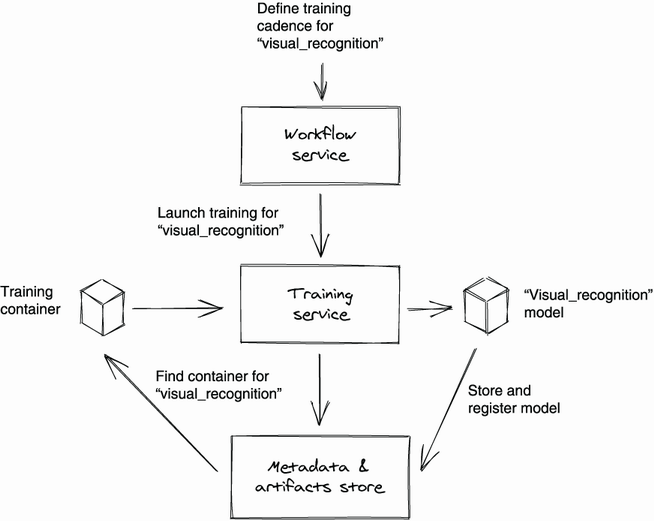
Follow the production training path: workflow orchestration selects a training flow, the trainer runs it, and the store supplies code and retains the model with metadata. section 10.2.4
