A metadata store is a persistence service for finding, versioning, and relating models and other machine-learning artifacts. It keeps descriptive records—such as model ID, name, version, algorithm, training data, metrics, code version, and artifact location—while model files themselves reside in artifact storage. This separation lets services search metadata first, then retrieve the required files. section 7.5.1 section 8.1
In a serving workflow, training registers a successful model and its metadata. A prediction service resolves a requested model ID or name/version through the store, downloads its files to shared storage, and routes the request to a compatible predictor using metadata such as algorithm type. Serving-code and training-code versions can also be recorded to select an appropriate predictor implementation. section 7.1.2 section 7.5.2 section 7.1.4
A practical store design separates lookup from descriptive records:
- Keep metadata objects in a metadata list and place a lookup table in front for searches by model name/version or model ID. section 7.5.1
- Store a pointer to model files in cloud object storage rather than embedding the files in the metadata record. section 7.5.1
- Correlate models, training runs, datasets, parameters, code, and metrics to expose lineage and support reproduction or troubleshooting. section 8.2.2 section 8.3.1
Release through a stable tag
Register model A version 1.0.0, then map the PROD tag to that version in the lookup table. Requests to /predict/model_A/PROD resolve to 1.0.0. Moving PROD to 1.2.0 changes which version new requests load without requiring callers to change their API request. section 7.5.3
Figure 7.13 The internal storage design of the metadata store; model metadata are stored as object files with lookup tables in front of them.
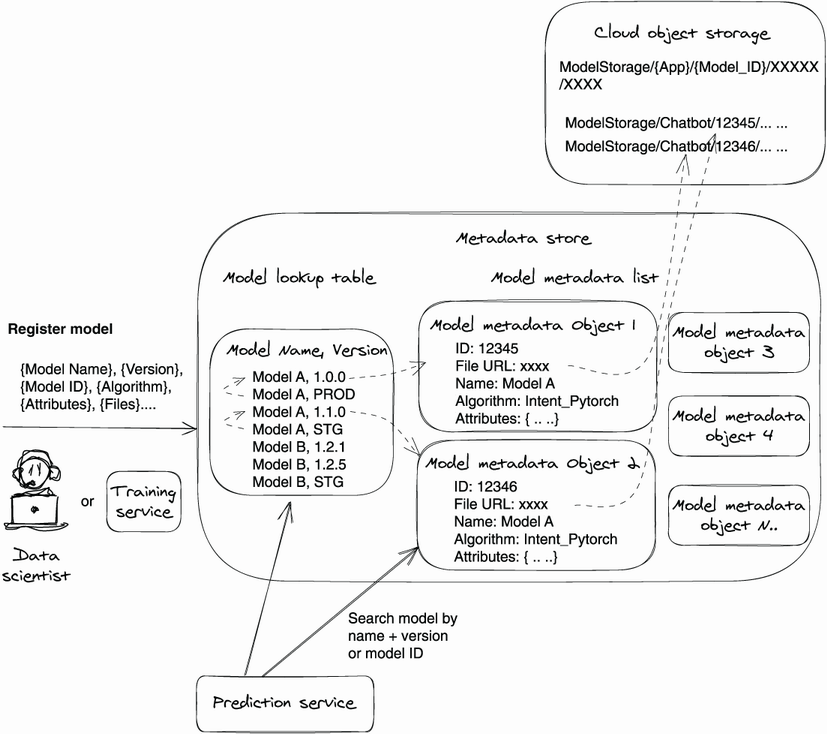
This storage view shows metadata objects behind lookup records, with model versions searchable independently of their artifact files. section 7.5.1
