A WebAssembly runtime is the host environment for a Wasm module outside the browser. It loads and executes the module, translates its platform-independent instructions for the host, and supplies the controlled system interactions the module cannot access on its own. WASI defines a system interface that runtimes can implement for operating-system interaction. section 1.0 section 1.2.1
Think of the runtime as the layer between application logic and the operating system, much as a Docker engine sits between containers and the host. A Wasm package generally carries application logic rather than a full userspace environment; the runtime and WASI provide the portable boundary to host resources. This can yield smaller artifacts and faster startup, but portability depends on runtime implementations of WASI. section 7.1 section 1.0
A runtime makes server-side Wasm practical by providing these boundaries:
- Execute a module while mediating its interaction with operating-system resources. section 1.0 section 2.6
- Grant explicit capabilities, such as standard output, instead of allowing unrestricted native OS access. section 1.2.4
- Implement WASI so modules can communicate with host operating systems without assuming a particular environment. section 7.1
- Provide lightweight isolation for independently running components, limiting the blast radius of a compromised module. section 1.2.4
A custom runtime for Hello, World
A small Rust-to-Wasm application accepts a string and returns it with “Hello, ” prefixed. Because raw Wasm has no built-in String type, the example uses low-level memory and data handling, then executes the module through a custom runtime. The exercise exposes the guest-host boundary before higher-level interface abstractions such as WIT are introduced. section 2.0 section 2.6
Runtime selection involves trade-offs rather than a blanket performance claim. Benchmarks cited for standalone and short-running workloads show close-to-native execution or faster starts than containers, while complex applications can be constrained by missing multithreading support. Language support can also vary, and targeting Wasm may require giving up packages that lack Wasm support. section 1.2.2 section 1.5
Figure 7.2 A side-by-side comparison of the execution models for containers and Wasm, showing how both systems provide an abstraction layer between applications and the host operating system
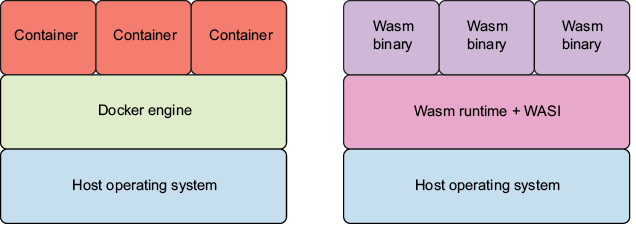
Compare the runtime-plus-WASI layer with the Docker engine layer to see why Wasm packages application logic while containers commonly include a userspace environment. section 7.1

