liveBook · Manning

Wasserstein distance

As explained in Evolutionary Deep Learning: Genetic algorithms and neural networks

A distance between probability distributions that measures the minimum transport cost required to transform one distribution into another.

Wasserstein distance measures how much transport is required to transform one probability distribution into another. In generative adversarial networks, it provides an earthmover-style loss that compares real and generated data through a scaled distance rather than probability uncertainty. section 9.3.1

The GAN formulation changes the training signal in several practical ways:

  • Replaces the discriminator’s real/fake probability with a critic score representing how real or fake an image is. section 9.3.1
  • Measures vertical as well as horizontal differences between distributions, unlike the probabilistic comparison described for Kullback–Leibler and Jensen–Shannon distances. section 9.3.1
  • Aims to make GAN training more robust and less sensitive while reducing mode collapse, convergence failure, and vanishing gradients. section 9.3 section 9.3.1

Using Wasserstein loss in a DCGAN

A DCGAN implementation renames the discriminator as a critic, compiles it with wasserstein_loss, and computes the loss as the mean of true labels multiplied by predictions. Both generator and critic use RMSprop with a learning rate of 0.00005. After each critic iteration, clipping every layer’s weights to ±clip_value limits exploding gradients. The experiment trains on one extracted MNIST digit class for 80 epochs and can be switched to Fashion-MNIST. section 9.3.2
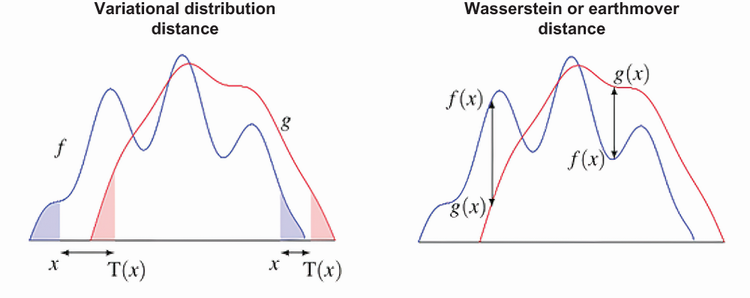
Figure 9.10 The difference between variational distance and Wasserstein distance

Compare probabilistic distance with earthmover distance through the supplied distribution diagram. section 9.3.1


How Evolutionary Deep Learning: Genetic algorithms and neural networks covers it

How deep it goes
Explains the critic concept and distribution intuition, then implements loss, optimizer, and weight clipping without formal derivation.
Examples
Demonstrates a Wasserstein DCGAN with MNIST digits, optional Fashion-MNIST data, RMSprop, critic training, and clipped weights.
What it assumes
Assumes familiarity with GANs and DCGAN training while presenting the Wasserstein-loss changes incrementally through an existing implementation.
What you can do after
Apply it via Python and Keras by adapting a DCGAN with a critic, Wasserstein loss, shared RMSprop settings, and weight clipping.
How it connects
Connects Wasserstein distance to GANs, critics, generators, discriminators, mode collapse, vanishing gradients, and convergence failure.

Also explained in

Compare how 4 books explain Wasserstein distance →

Related concepts

This explainer was generated by Manning's knowledge graph from the text of Evolutionary Deep Learning: Genetic algorithms and neural networks. The section links point to the parts of the book it draws on.

