liveBook · Manning

Weak instrument

As explained in Causal Inference for Data Science

A weak instrument is an instrumental variable that has a small effect on the treatment variable, causing the instrumental-variable estimator to have high variance and potential numerical instability.

Suppose a company assigns customers to receive a chatbot but many assigned customers never use it. If assignment barely changes chatbot usage, the assignment is a weak instrument. The instrument may technically satisfy relevance, yet its small effect on treatment makes the instrumental-variable estimate unstable and imprecise. section 9.3.2

The IV estimator divides the instrument–outcome association by the instrument–treatment association. When the denominator, such as E[D|Z = 1] − E[D|Z = 0] or cov(D, Z), approaches zero, small numerator errors become much larger, increasing estimator variance. section 9.3.2

A practical check compares repeated estimates under different instrument strengths:

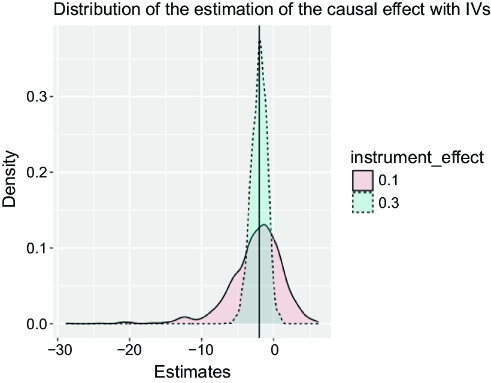
  • Generate synthetic data and estimate the causal effect 1,000 times. section 9.3.2
  • Compare an instrument effect of 0.3 with a weaker effect of 0.1. section 9.3.2
  • Expect the weaker instrument to produce a wider, higher-variance distribution of estimates. section 9.3.2
Figure 9.8 A lower effect of the instrument on the treatment variable leads to a higher variance in the estimation.
figure

The figure visualizes how reducing the instrument’s effect on treatment increases the variance of the IV estimate. section 9.3.2

How Causal Inference for Data Science covers it

How deep it goes
Explains denominator instability and demonstrates variance inflation through repeated simulations, without developing further weak-IV remedies.
Examples
Uses chatbot assignment, IV covariance formulas, and R or Python simulations with instrument effects of 0.3 and 0.1.
What it assumes
Assumes familiarity with instrumental-variable formulas, covariance, treatment, outcome, and causal estimation.
What you can do after
Evaluate IV reliability by identifying a near-zero first-stage association and simulating the resulting estimate distribution.
How it connects
Connects instrumental variables with relevance, treatment variables, causal effects, IV estimators, and estimation variance.

Related concepts

This explainer was generated by Manning's knowledge graph from the text of Causal Inference for Data Science. The section links point to the parts of the book it draws on.