Suppose several friends answer the same question. Each may get some answers wrong, but a vote can give a different answer from any one friend. A weak learner plays a similar role: it is an individual predictive model trained to contribute to a combined model, called a strong learner. In these examples, weak learners are usually small decision trees. They can be used for classification or regression. section 12.1 section 12.0
How the learners are trained and combined depends on the ensemble method:
- Bagging trains learners on random samples of the data. For classification, their predictions are combined by voting; for regression, they are averaged. section 12.1
- AdaBoost trains learners in sequence. After each one, incorrectly classified points receive more attention; the learners then contribute to a score-weighted vote. section 12.3
- Gradient boosting trains later learners to predict residuals—the differences between labels and the combined prediction so far. Their predictions are added using a learning rate. section 12.4
Spam or ham?
Imagine classifying emails using counts of the words “lottery” and “sale.” One deep decision tree fits the training emails perfectly but bends its boundary to classify two isolated points. Instead, a manually built random forest trains three depth-1 trees on random subsets. Each tree supplies a simple boundary, and their votes determine the forest’s prediction. A Scikit-Learn forest with five depth-1 trees classifies the data well while treating the two troublesome points as outliers. section 12.2
Figure 12.6 The way to obtain the predictions of the random forest is by combining the predictions of the three weak learners. On the top, we can see the three boundaries of the decision trees from figure 12.5. On the bottom, we can see how the three decision trees vote to obtain the boundary of the corresponding random forest.
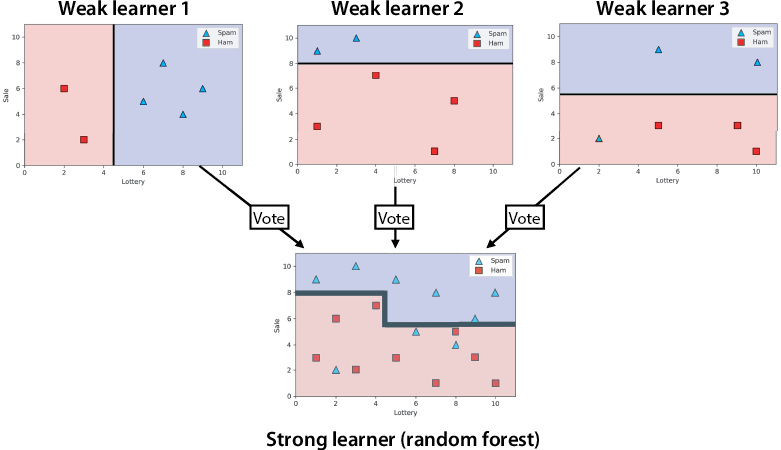
Compare the three shallow-tree boundaries with the boundary produced by their votes. section 12.2
Boosting gives weak learners a different job. In an AdaBoost classification example, each learner is a depth-1 tree trained on the whole dataset. Misclassified points are enlarged before the next tree is fitted. The trees receive scores based on their accuracy, so their votes need not have equal weight. A random forest, by contrast, gets its learners from random data subsets rather than repeatedly focusing on earlier mistakes. section 12.3 section 12.2
Predicting app engagement
For eight users, age is used to predict days of app use per week. A gradient-boosting model begins with a depth-0 tree that predicts the average label, 4, for everyone. It calculates each residual as the actual label minus that prediction, then fits a new tree to the residuals. With a learning rate of 0.8, an initial prediction of 4 and a second-tree prediction of 3 combine as 4 + 0.8 × 3 = 6.4. Further learners fit the remaining residuals. section 12.4
XGBoost also fits trees to residuals. Its tree-building procedure uses a similarity score to choose splits and prunes splits that fail a minimum-gain condition. Weak learners therefore need not all have the same shape or depth across methods. To see their contribution yourself, fit a shallow random forest or AdaBoost classifier to a small labeled dataset, inspect its individual trees, and compare their predictions with the ensemble’s. section 12.5 section 12.2 section 12.3


