The whirlpool model treats collaborative modeling as repeated feedback loops rather than a linear design process. Teams challenge models from different perspectives, using conversations, conflicts, biases, and new insights to refine their understanding. section 11.3.1
Figure 11.7 Model Exploration Whirlpool from Eric Evans. This whirlpool helps in considering collaborative modeling as a collection of feedback loops, rather than a linear process. (Source: www.domainlanguage.com/ddd/whirlpool/)
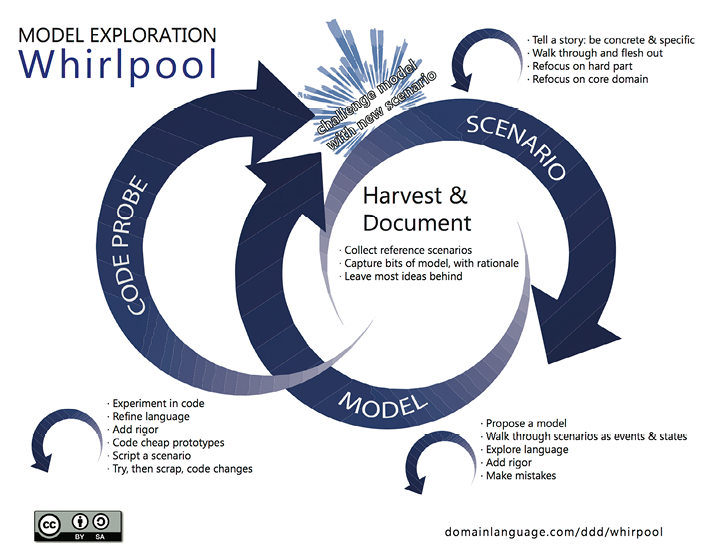
Use the whirlpool diagram to frame collaborative modeling as connected loops of exploration, feedback, and revision. section 11.3.1
A practical exploration cycle can:
- Harvest and document the current state with EventStorming, Business Model Canvas, or Wardley Mapping. section 11.3.1
- Explore multiple scenarios and propose models, revisiting them as conversations reveal conflicts, biases, or missing knowledge. section 11.3.1
- Share the model beyond the original group and expect further iterations as new perspectives emerge. section 11.3.1
EventStorming to refined model
After an EventStorming session, let the model settle, then revisit it through further conversations and alternative scenarios. The value lies in the modeling process, not merely its final output. section 11.3.1
