A decision layer is shared authorization infrastructure that evaluates access requests through a common policy framework instead of leaving each application to interpret permissions on its own. It turns authorization from scattered feature logic into a governed way to decide which actions may proceed across an organization. section 19.2 section 19.3
Consider an organization where one service trusts VPN membership, another checks a hard-coded role, and a third relies on a local group or IP range. Similar requests can receive different answers, and investigators must reconstruct application code to understand why. A decision layer supplies a consistent structure for evaluating those requests, making decisions easier to explain, audit, and change. section 15.6 section 15.6
A decision layer separates responsibilities while bringing the information needed for runtime decisions together:
- Product teams express domain-specific policies aligned with business goals rather than embedding authorization logic directly in services. section 19.2
- Identity and security teams maintain foundational policies for organization-wide requirements such as authentication strength and device posture. section 15.6 section 19.2
- Operational teams express workflow constraints, such as on-call deployment requirements, without placing the rules in scripts or dashboards. section 15.6
- Policies evaluate relationships, attributes, and contextual signals at runtime; missing or stale signals can produce predictable fail-closed behavior. section 19.2 section 15.6
One framework, several kinds of access
The same decision layer can answer whether an employee may share a document, whether a partner may invoke an API, or whether an agent may execute a workflow. The requests differ, but they are governed through the same policy framework. This consistency supports new collaboration and automation without requiring every team to invent a separate authorization approach. section 19.3 section 19.2
The value is not merely centralized enforcement. Shared decisions create a common language across teams, reduce security drift, and allow policy changes without coordinating code changes across many services. Clear policy and context also let analysts explain an allow or deny decision, while defined owners for foundational, operational, and application policies keep governance aligned with business intent. section 15.6 section 15.6 section 19.2
Figure 19.2 ACME’s expanding decision surface and strengthening decision infrastructure. As ACME moved from document sharing to customer collaboration, APIs, partners, automation, and agents, the situations requiring authorization decisions became broader and more dynamic. ACME responded by building cumulative decision infrastructure: ACLs and roles, relationship and attribute models, policy engines, contextual signals from PIPs, governance, and explicit delegation. These layers are not one-to-one mappings to the items above them; together they show how authorization became shared infrastructure for governing authority across the enterprise.
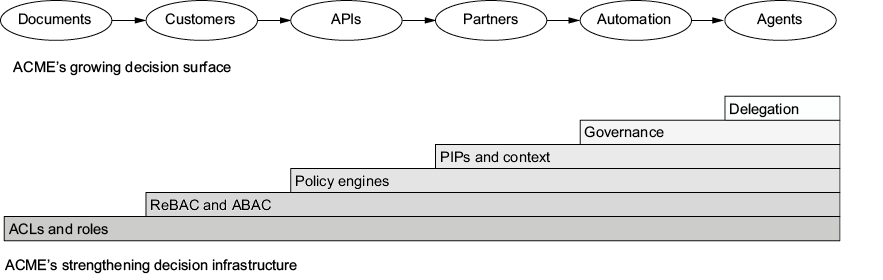
This figure relates a growing decision surface—documents, APIs, partners, automation, and agents—to cumulative decision infrastructure: ACLs, roles, relationship and attribute models, policy engines, contextual signals, governance, and delegation. section 19.2
Table 15.1 Organizational benefits of ACME’s zero-trust security architecture
| Benefit |
What has improved |
Why it matters |
|---|---|---|
| Consistent access decisions |
Authorization logic behaves the same across applications and tools. |
Reduces confusion, support tickets, and inconsistent user experiences |
| Better access for legitimate users |
The right people get access quickly and reliably. |
Improves productivity for employees, vendors, and customers |
| Clear separation of concerns |
Foundational, shared operational, and application policies have distinct owners. |
Reduces friction between teams and aligns policy with business intent |
| Faster auditing and incident response |
Decisions can be explained by examining policy and context. |
Helps analysts understand why access was allowed or denied, reducing investigation time |
| Reduced security drift |
Enterprise-wide requirements are enforced everywhere. |
Prevents divergence in how systems interpret roles, posture, and risk |
| Less perimeter dependence |
Fewer VPN/IP exceptions and network-based assumptions |
Modernizes the architecture and reduces exposure from lateral movement between systems |
| Lower operational overhead |
No need to duplicate authorization logic in each application |
Developers write fewer exceptions; pipelines need fewer one-off checks. |
| Automatic adoption of new requirements |
Foundational policies apply to systems without code changes. |
Speeds up the adoption of new security controls and reduces refactoring |
| Better governed access |
Policies are reviewable, testable, auditable artifacts. |
Turns governance from just documentation into executable rules |
| Higher architectural resilience |
Unified evaluation plus strong signals equal safer failure modes |
Systems fail closed when context is missing or stale. |
This table summarizes the operational consequences of a shared decision layer, including consistent access decisions, clearer ownership, faster auditing, and reduced security drift. section 15.6
