After booting and obtaining an IP address, a lightweight access point (LWAP) searches for available wireless LAN controllers (WLCs) before joining one. A nearby WLC can receive the AP’s broadcast discovery messages, allowing automatic registration without manual AP configuration. section 21.3.4
The AP uses these discovery methods:
- Broadcast discovery messages sent across the local LAN. section 21.3.4
- Previously joined WLCs remembered by the AP. section 21.3.4
- WLC addresses manually configured through the AP CLI. section 21.3.4
- WLC addresses learned through DHCP option 43. section 21.3.4
- DNS resolution of CISCO-CAPWAP-CONTROLLER.local-domain. section 21.3.4
Same-LAN discovery
AP1 connects to SW1, boots, receives an IP address, and discovers WLC1 through LAN broadcasts. DHCP option 43 also supplies WLC1’s address, but it is unnecessary in this same-LAN scenario. After joining, AP1 receives WLAN, band, channel, and transmit-power settings from WLC1. section 21.3.4
Figure 21.23 AP1 (with its default hostname) automatically joined with and is managed by WLC1 without any manual configuration.
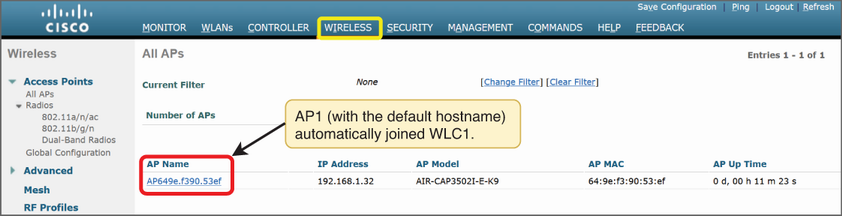
View the automatic association in which AP1 joins and becomes managed by WLC1 without manual AP configuration. section 21.3.4
