WordPress is an open-source content management system written in PHP. It stores posts, comments, and other content in MySQL, while uploads, plugins, themes, and application files remain on disk. section 2.0 section 2.2.3
A highly available AWS deployment places an Application Load Balancer in front of at least two EC2 web servers. RDS for MySQL stores database content, EFS shares files across servers, and security groups restrict network traffic. section 2.1
A practical WordPress proof of concept uses:
- An Application Load Balancer that routes HTTP or HTTPS requests only to healthy web servers. section 2.1
- Amazon Linux or another supported operating system running Apache, PHP, and WordPress on EC2. section 2.1
- RDS for MySQL, sized for the workload, with AWS-managed backups, patches, updates, and optional replication. section 2.1 section 2.2.3
- EFS for shared application files, uploads, plugins, and themes that every web server must access. section 2.1 section 2.2.3
- Security groups that expose HTTP at the load balancer and limit database access to the web servers. section 2.1
Blog migration proof of concept
A company serving roughly 1,000 daily visitors can recreate its blog on AWS, estimate monthly infrastructure costs, evaluate a 99.99% uptime goal, and delete the stack afterward. A small RDS instance with one virtual CPU and 1 GB of memory is described as sufficient for this workload. section 2.0 section 2.2.3
Figure 2.1 The company’s blogging infrastructure consists of two load-balanced web servers running WordPress, a network filesystem, and a MySQL database server.
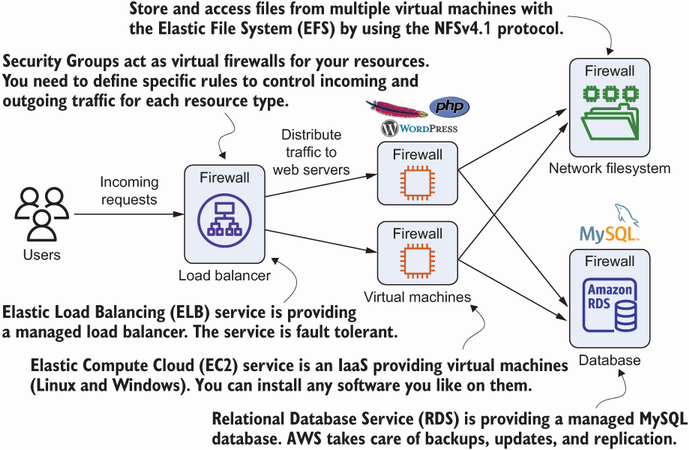
Use the architecture figure to trace traffic from the load balancer through two WordPress web servers to shared files and the MySQL database. section 2.1

