Work in progress is started work that has not yet reached a customer. Keeping too much of it open ties up time and money, delays feedback, and allows changes and bugs to accumulate. Smaller increments move value through the delivery process earlier and more often. section 1.2
Reduce WIP by shaping delivery around a short feedback loop:
- Turn ideas into small, usable pieces instead of developing a large feature unseen for weeks. section 1.2
- Move committed code through automated quality checks, builds, and delivery. section 1.1
- Use customer and team feedback to adjust the next increment rather than guessing far ahead. section 1.2 section 1.1
A feature left untouched
A developer spends three weeks building a feature before anyone tests it. Testing then uncovers many bugs, while the surrounding product has changed and fixes are slow. Splitting the feature into smaller pieces exposes problems sooner, shortens feedback cycles, and reduces the revenue held in unfinished work. section 1.2
Figure 1.4 Product development goes through a life cycle that starts with raw materials and results in a product that customers provide feedback on, resulting in improvements and changes to the product.
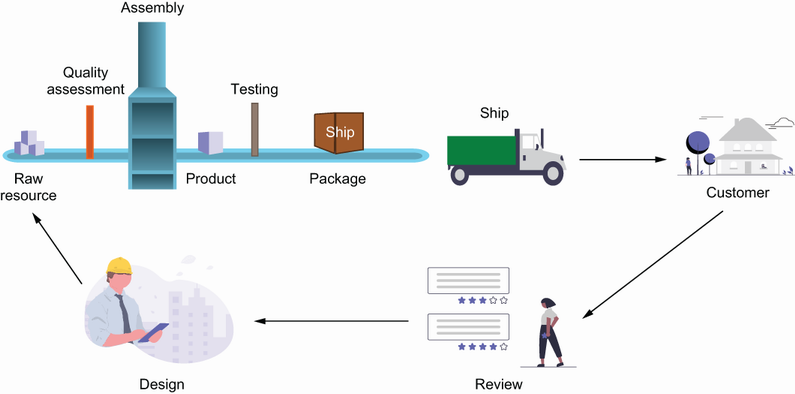
Use the product-development life cycle to trace how work moves from raw inputs through delivery, customer feedback, and improvement. section 1.2

