A world model is an organized internal representation of objects, agents, causes, constraints, and possible outcomes. It supports prediction, planning, and adaptation by representing how situations can change. A cup can spill, for example, and removing a support can cause an object to fall. section 9.4.3
A world model is more than a collection of associations. In a demanding sense, it maintains entities and their relations as a situation evolves. This distinction matters when judging neural networks: similar internal representations can emerge across models trained on different data, but shared structure alone does not establish a persistent, evolving model of a world. section 5.4.5
Repeated interaction can connect a world model to perception, action, and consequences. Humans learn practical relations not only by describing a chair, but by sitting on it, moving around it, or avoiding it. This connection supports a critique of language models: describing such relations may not be equivalent to participating in them. section 9.4.3
Figure 9.10 Embodied interaction and cognition. Through repeated interaction and consequences, an agent can develop a world model, exercise agency, and represent itself within the environment. These capacities remain closely connected, each shaping and constraining the others.
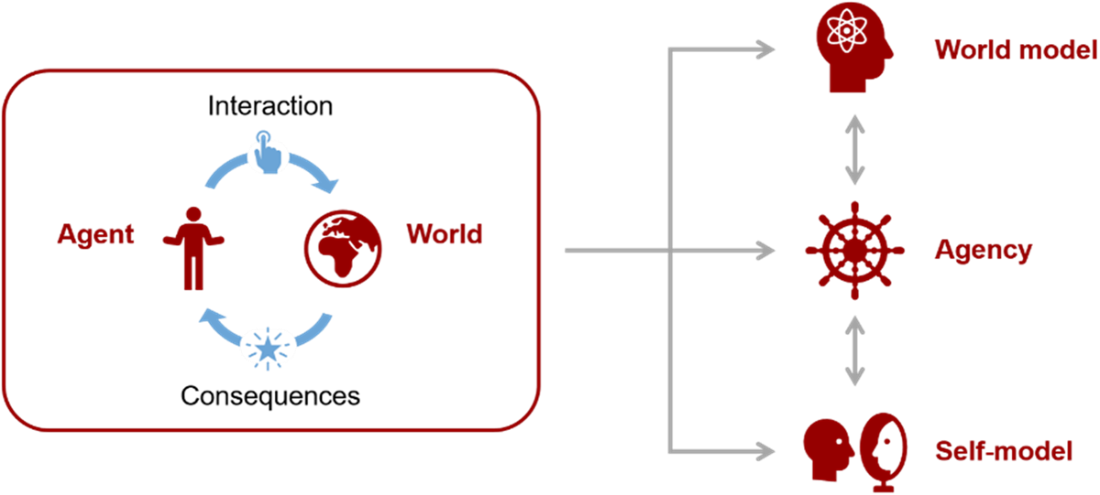
Shows how interaction and consequences connect world models with agency and self-representation. section 9.4.3
Language nevertheless records extensive practical and causal knowledge. A model trained on it may acquire functional expectations useful for planning, engineering assistance, or counterfactual reasoning, even if those expectations are not grounded like an animal’s action-tested model. This leaves room for partial, language-shaped world models without equating them with embodied understanding. section 9.4.3 section 9.5.3
Testing unfamiliar environments
ARC-AGI-3 illustrates a limitation: current systems struggle when they must explore an unfamiliar environment, infer its rules, and act efficiently within it. Such failures challenge claims of robust world modeling, but do not prove that a system has no world model at all. section 9.5.3



