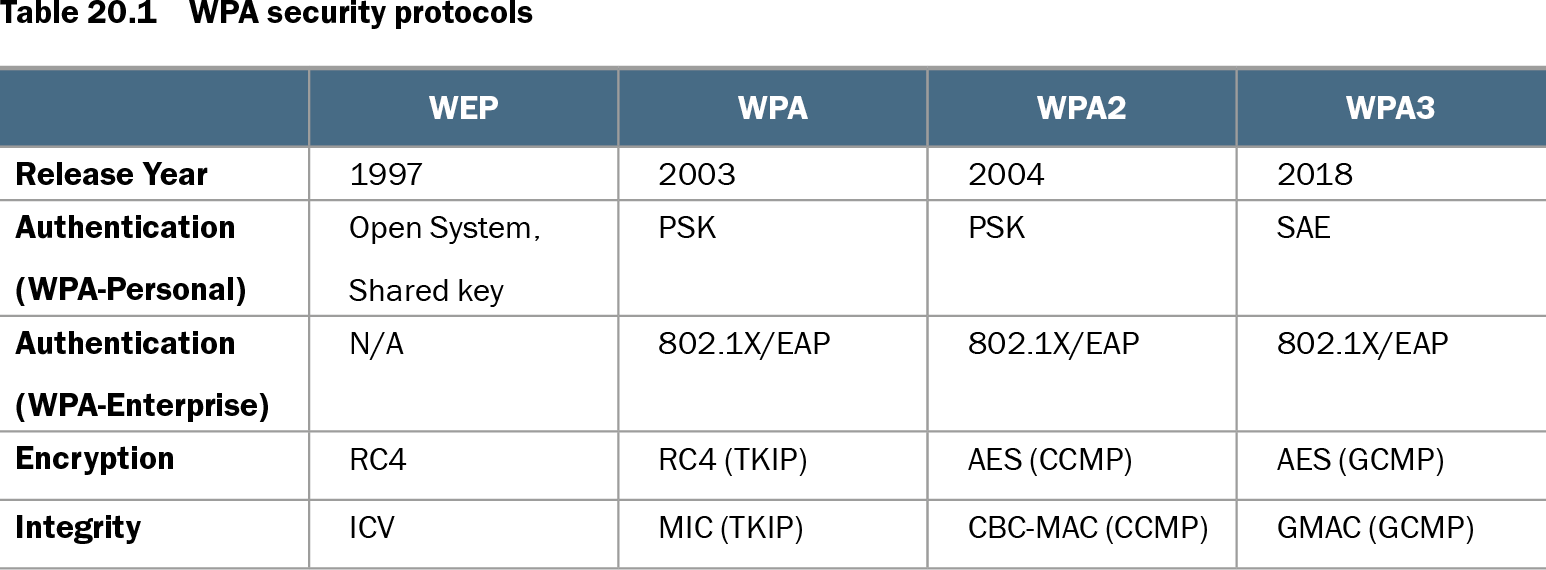
WPA3 is the current Wi-Fi security certification generation, designed to protect wireless communications through stronger authentication, confidentiality, and integrity than earlier WPA versions. section 20.0 section 20.4
WPA3-Personal retains a pre-shared key but replaces vulnerable WPA/WPA2 PSK authentication with Simultaneous Authentication of Equals (SAE). SAE occurs before association, lets the client and AP verify matching PSKs without exposing them to practical brute-force attacks, and is followed by the four-way handshake that generates encryption keys. Users still enter an 8- to 63-character passphrase. section 20.2 section 20.2.1
Use these distinctions when identifying WPA3 security behavior:
- WPA3-Personal uses SAE with a shared passphrase; WPA3-Enterprise uses 802.1X and EAP with individual user or device credentials. section 20.2
- The four-way handshake confirms matching authentication material and generates unique encryption keys; SAE does not eliminate the risks of passphrase compromise through social engineering. section 20.2.1
- WPA3 makes Protected Management Frames mandatory and provides Forward Secrecy, preventing a compromised PSK from decrypting past communications. section 20.4
Figure 20.5 WPA3-Personal authentication using SAE. SAE authentication allows the client and AP to confirm they have the same PSK and derive a key used in the four-way handshake. In the four-way handshake, they generate the encryption keys used to encrypt/decrypt data messages.
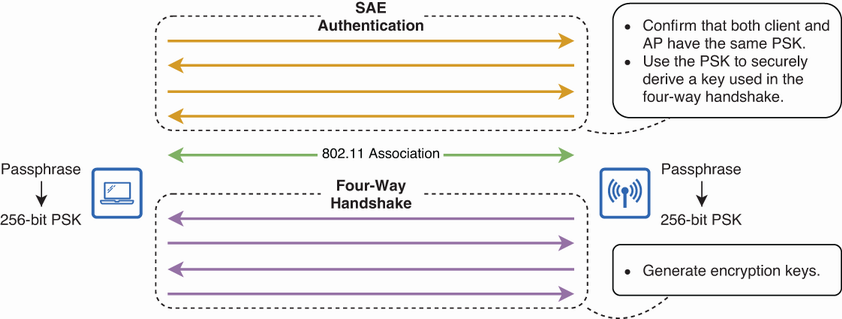
Trace WPA3-Personal from SAE verification through the four-way handshake and session-key generation. section 20.2.1
Table 20.1 WPA security protocols (view table figure)
| WEP |
WPA |
WPA2 |
WPA3 |
|
|---|---|---|---|---|
| Release Year |
1997 |
2003 |
2004 |
2018 |
| Authentication (WPA-Personal) |
Open System, Shared key |
PSK |
PSK |
SAE |
| Authentication (WPA-Enterprise) |
N/A |
802.1X/EAP |
802.1X/EAP |
802.1X/EAP |
| Encryption |
RC4 |
RC4 (TKIP) |
AES (CCMP) |
AES (GCMP) |
| Integrity |
ICV |
MIC (TKIP) |
CBC-MAC (CCMP) |
GMAC (GCMP) |
Compare WPA generations by release year, authentication, encryption, and integrity protocols. section 20.4