A wrapper mediates an agent’s access to an external operation. It exposes a bounded enterprise capability rather than a vendor platform, schema, screen, or API family. For SaaS, it narrows permitted operations, fields, and workflow transitions without replacing vendor identity or authorization controls. For legacy systems, it preserves operational boundaries such as approval queues, batch windows, exception handling, supervisor checks, and data restrictions. section 6.3.2
The wrapper also absorbs execution uncertainty before it reaches the agent’s planning loop. A lost confirmation may mean that a business effect occurred, did not occur, or cannot be confirmed; the wrapper resolves these states instead of allowing an uninformed retry. section 6.3.3
A governed wrapper should:
- Restrict each invocation to the agent’s delegated purpose, relevant record or lot, permitted fields, and approved workflow transitions. section 6.3.2
- Preserve controls embedded in operating practice rather than bypassing them because an interface does not represent them explicitly. section 6.3.2
- Check the conversational-contract instance before retrying; return the prior outcome, permit a controlled retry, or compensate, defer, or escalate. section 6.3.3
- Derive the idempotency key from the contractInstanceId and enterprise-issued businessEffectId rather than letting the agent invent it. section 6.3.3
A lost confirmation during a quality investigation
An agent publishes a containment recommendation or places a lot hold, then receives no confirmation. An ungoverned retry can duplicate the business action or split the evidence trail. The wrapper checks the prior effect for the contract instance: it returns the existing result when found, retries only when absence is known, and otherwise compensates, defers, or escalates. section 6.3.3
Figure 6.3 Why integration uncertainty requires governed wrappers. Without a wrapper (left), a confirmation timeout drives the agent to retry, and the enterprise sees a duplicate business effect with no linked evidence. With a governed wrapper (right), the retry is resolved against the prior effect recorded for the conversational contract instance, so uncertainty is absorbed at the boundary rather than leaking into the agent loop.
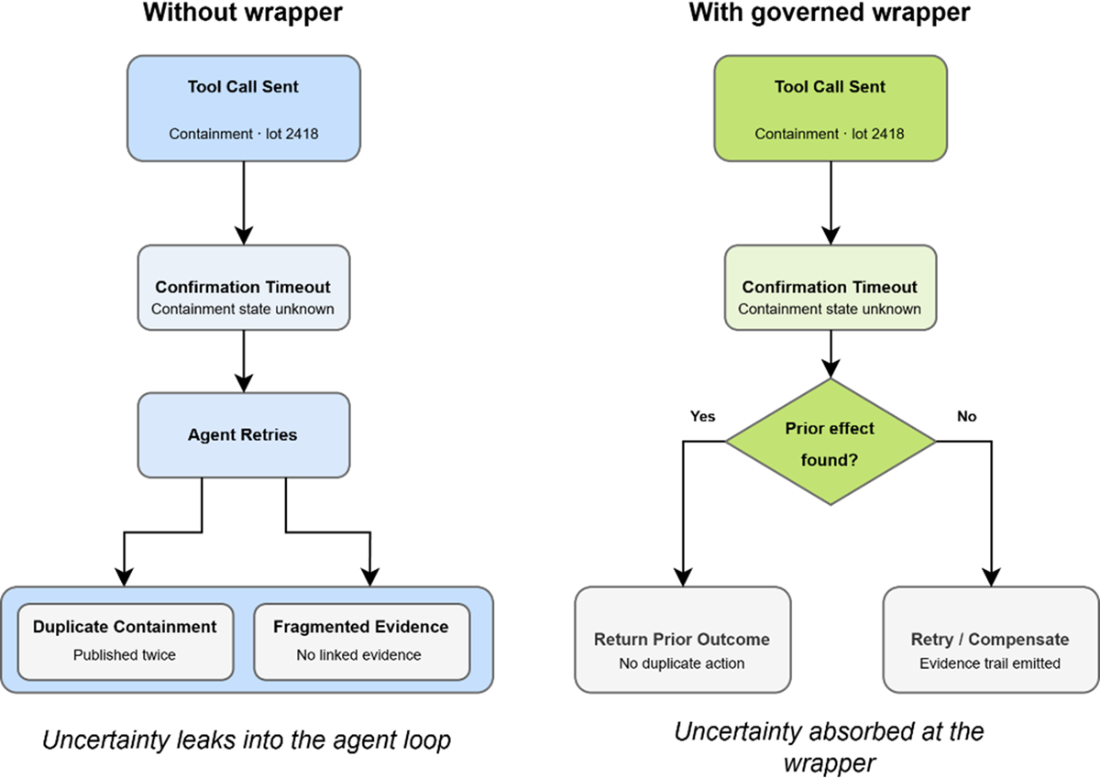
Compare an unwrapped timeout-driven retry with a governed wrapper that resolves the prior business effect and keeps uncertainty at the integration boundary. section 6.3.3