X-as-a-service (XaaS) is a way for one team to use another team’s capabilities without continually coordinating their work. Calling another team’s API is one example. Onboarding, feature requests, and support may still be needed, but they should cost substantially less than an ongoing collaboration relationship. section 11.2.2
Choose the interaction mode to fit the work. Collaboration helps two teams stay closely aligned on a shared outcome, but its rituals and joint decisions add cognitive load. When that alignment no longer justifies the cost, consider moving to XaaS. Facilitation is different: one team temporarily helps another achieve its goal or learn a skill. section 11.2.2
Reducing handovers at a telco
In a European telco’s broadband self-fulfillment value stream, manual processes and escalation paths left teams waiting for decisions or work outside their teams. A redesigned team topology grouped related responsibilities, clarified system ownership, and replaced costly handovers and collaboration with XaaS relationships. Platform engineering served other teams this way; the website platform also exposed capabilities consumed by order management and activation teams. section 15.2
Map where teams must repeatedly synchronize, hand work over, or wait on decisions. Discuss whether close collaboration is still necessary, rather than treating every dependency as a candidate for XaaS. Boundaries can change: two teams may collaborate while discovering responsibilities, then move toward XaaS as those responsibilities become clearer. Revisit the arrangement if awkward interactions or slower delivery emerge. section 11.6 section 15.2
Figure 15.4 To-be Team Topologies with few minimal paths to support the self-fulfillment of an internet broadband package value stream
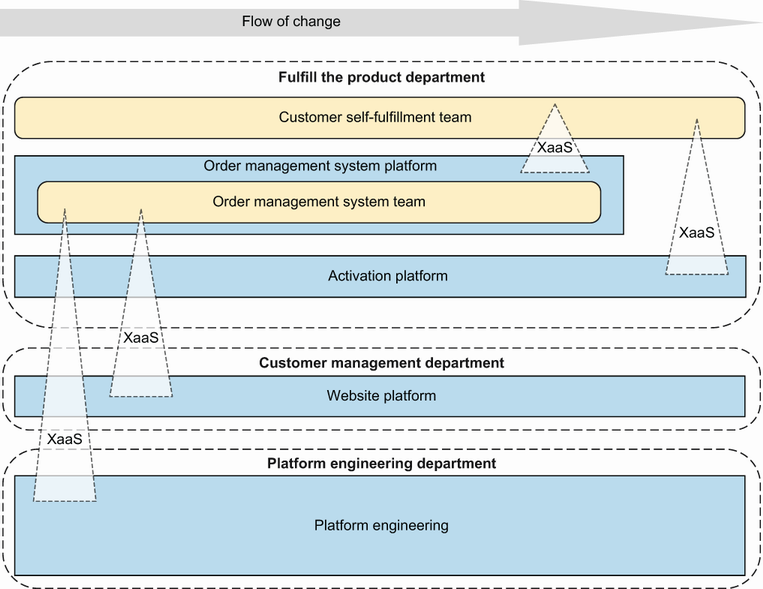
The proposed telco team topology shows the reduced interaction paths supporting broadband self-fulfillment. section 15.2

