Zero-shot learning applies a pretrained model to a new task without task-specific labeled examples or further training. For protein mutation screening, a model trained on amino acid sequences can score variants before they are tested in the laboratory. section 12.3.5 section 12.4
A protein language model assigns probabilities to amino acids based on their sequence context. To score a substitution, mask the position and compare the predicted probability of the mutant amino acid with that of the wild type, the original amino acid. The score is the log probability of the mutant minus the log probability of the wild type. A higher score means the model considers the substitution more plausible in that context. section 12.3.5
Screening a protein mutation
To assess a change from alanine to cysteine at position 42, mask that position and compare the model’s probabilities for cysteine and alanine. The resulting score can help prioritize variants for experiments; evolutionary plausibility is not itself an experimental measurement of function. section 12.3.5
Figure 12.12 A zero-shot mutation landscape predicted by ESM-2. The x-axis represents the residue position, and the y-axis represents the 20 possible AA mutations. The color indicates the Log-Likelihood Ratio (LLR): brown regions indicate deleterious mutations that the model views as evolutionarily unlikely, while white/blue regions indicate neutral or beneficial mutations.
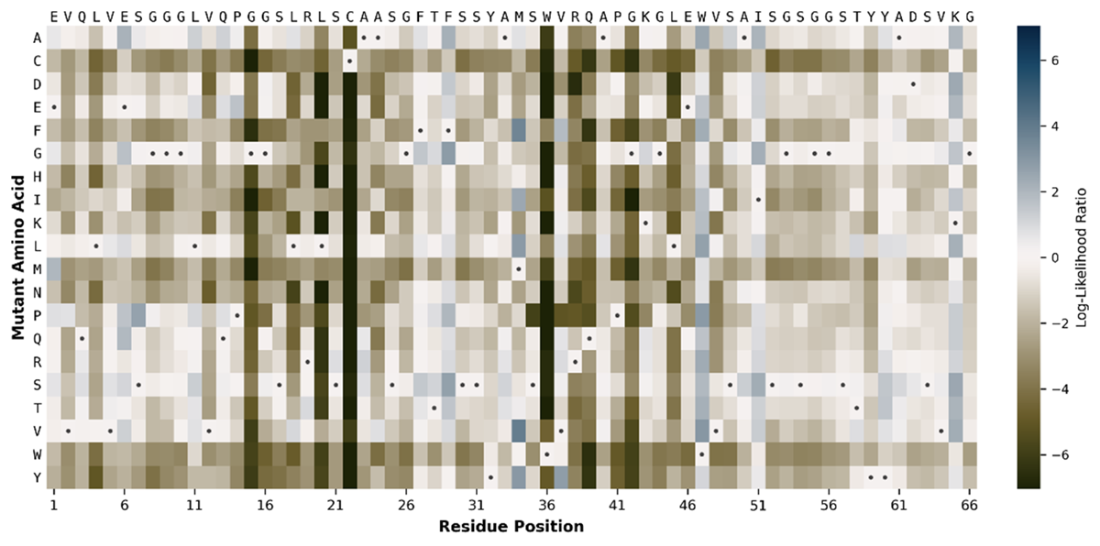
The mutation landscape shows predicted log-likelihood ratios across sequence positions and possible amino acid substitutions. section 12.3.5











