INT8 represents values with uniformly spaced levels. In symmetric INT8 quantization, the scale sets the maximum representable magnitude; the spacing therefore depends on that scale. section 8.2.1
Choose between INT8 and other low-precision formats by considering the value distribution and scaling granularity:
- For values concentrated near zero, FP8 E4M3 has 49 representable values in [0, 0.5], compared with INT8 symmetric's 32. For a uniform distribution, INT8 is identified as the better choice. section 8.2.1
- For weight reconstruction, per-channel INT8 scaling achieved lower MSE than per-tensor FP8 in the OPT-6.7B fc1 comparison; reconstruction MSE alone does not determine end-to-end perplexity. section 8.2.3
Figure 8.2 Representable values in [0, 8]. E4M3 and E5M2 cluster their values exponentially—dense near zero, sparse at larger magnitudes. INT8 symmetric spaces all 128 positive values uniformly, so its coverage ends abruptly at the scale-dependent maximum (here ≈2, assuming scale = 0.0157). Beyond that boundary, INT8 cannot represent any value at all.
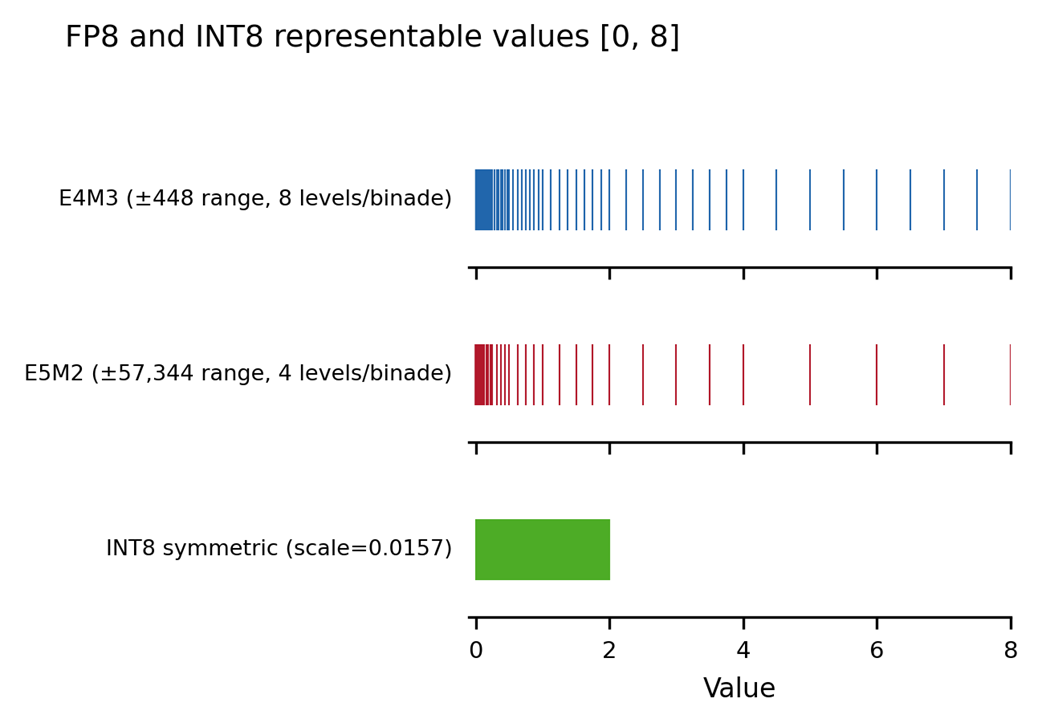
Compare how INT8's uniform spacing and scale-dependent range differ from FP8's denser values near zero. section 8.2.1
INT8 in a PTQ decision
A large CNN targeting INT8 with a 2% accuracy tolerance is described as a PTQ-trivial case; architecture, target bit-width, and tolerated degradation inform whether to escalate to QAT. section 4.1

