Integer
An integer is a whole-number mathematical value, including negative numbers, zero, and positive numbers, with no fractional part.

Python Workout, Second Edition
An integer is a whole-number numeric value without a fractional part, represented in Python by the int type.
- How it is used
- Uses integers for whole-number input, random values, comparisons, indexes, counters, and numeric calculations.
- How deep it goes
- Defines int and practices conversion, comparison, bases, and validation, but stops short of integer implementation internals.
- Examples
- Practices integers through a number-guessing game, run-time accumulation, hexadecimal conversion, and summing or averaging exercises.
- What you can do after
- Build integer-driven programs that parse input, compare values, generate random numbers, and accumulate numeric results.
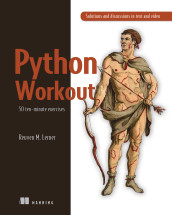
Python Workout: 50 ten-minute exercises
An integer is a Python numeric value representing a whole number without a fractional component.
- How it is used
- Uses integers for guesses, indexes, counts, conversions, calculations, and exact small-unit representations.
- How deep it goes
- Explains definition, conversion, comparison, validation, inclusive random ranges, and practical precision choices without covering integer internals.
- Examples
- Demonstrates guessing games, cents-based money, filtered numeric text, and file lines containing integer values.
- What you can do after
- Build it from scratch by converting input, generating integer ranges, comparing values, validating failures, and accumulating integer data.
Read how Python Workout: 50 ten-minute exercises explains integer →

Modern C, Third Edition
An integer type is a C type whose values represent whole numbers, with either signed or unsigned representation.
- How it is used
- Explains how integer types and literals determine value ranges and arithmetic behavior in C.
- How deep it goes
- Traces precision, promotions, literal typing, and signed representation, including platform-dependent cases.
- Examples
- Compares decimal and hexadecimal literals at integer limits and illustrates time fields stored as bit-fields.
- What you can do after
- Evaluate integer literal types and recognize portability constraints on precision and promotion.

Get Programming: Learn to code with Python
int is Python's built-in type and constructor for representing or converting values to integers.
- How it is used
- Represents whole-number values for arithmetic, type conversion, and calculations involving minutes or user input.
- How deep it goes
- Defines int, demonstrates arithmetic and several conversions, and works through extracting whole hours; does not examine integer storage internals.
- Examples
- Uses 123-minute conversion, a user-entered number squared, and integer-controlled string repetition.
- What you can do after
- Apply it via Python’s int() to convert numeric input and extract whole hours from a division result.
Read how Get Programming: Learn to code with Python explains integer →

Modern C
signed int is a C signed integer type capable of representing both negative and nonnegative integer values.
- How it is used
- Explains signed integer types as part of C's basic numeric types and rules for arithmetic and constants.
- How deep it goes
- Traces type selection and promotion, then examines sign representations and their bit-level differences.
- Examples
- Contrasts -32768 with -0x8000 on a specified platform and tabulates constant types under a 32-bit representation assumption.
- What you can do after
- Evaluate and understand how integer notation, range, and signedness affect the type of a negated constant.

Learn Rust in a Month of Lunches
An integer is a whole-number numeric value without a fractional part.
- How it is used
- Introduces whole-number values as Rust primitive types and uses them to teach type inference.
- How deep it goes
- Explains signedness, bit widths, binary representation, ranges, and type annotations with focused examples.
- Examples
- Uses u8 and u16 limits, annotated number literals, and a compiler error from casting i32 to char.
- What you can do after
- Apply integer type annotations in Rust and choose a type using signedness and value range.
Read how Learn Rust in a Month of Lunches explains integer →

Go in Action, Second Edition
An integer type represents whole-number values without a fractional component.
- How it is used
- Uses integers for arithmetic, indexing, and configuration arguments, with int as the general-purpose choice.
- How deep it goes
- Explains signed and unsigned ranges, architecture-dependent sizes, aliases, selection trade-offs, and wraparound.
- Examples
- Uses integer declarations, equivalent numeric literal notations, unsigned wraparound, and configuration-value validation.
- What you can do after
- Apply integer type selection and validate signed inputs while recognizing unsigned wraparound.

Learn PowerShell in a Month of Lunches: Fourth Edition, Covers Windows, Linux, and macOS
An integer is a whole number with no fractional or decimal portion.
- How it is used
- Clarifies numeric parameter requirements and prevents text input from producing incorrect PowerShell arithmetic.
- How deep it goes
- Defines whole numbers and demonstrates typed input, runtime inspection, arithmetic, command arguments, and conversion failures.
- Examples
- Demonstrates Read-Host input, [int] variables, multiplication, conversion errors, Get-Member inspection, and Get-Process -Id.
- What you can do after
- Apply it via PowerShell by declaring numeric variables, validating their runtime type, performing arithmetic, and supplying command identifiers.

Python How-To
int is Python's built-in numeric type for representing integers and the callable that constructs such values.
- How it is used
- Converts integer-valued strings into numbers for calculations, comparisons, and subsequent processing.
- How deep it goes
- Explains integer-string conversion, failed casts, and exception handling, without detailing int internals.
- Examples
- Uses positive and negative integer strings, age comparisons, and task urgency records, including malformed input.
- What you can do after
- Apply it via the int constructor to convert integer strings and handle invalid input with try...except.

The Quick Python Book, Fourth Edition
An integer is a whole-number value with no fractional component and, in Python, arbitrary magnitude subject to available memory.
- How it is used
- Uses integers for whole-number values and demonstrates their arithmetic and conversion in Python.
- How deep it goes
- Defines integer range, arithmetic result types, division, and conversions, including string parsing with an optional base.
- Examples
- Demonstrates integer arithmetic, large values, input conversion, and parsing strings in bases 2, 8, and 16.
- What you can do after
- Apply integer arithmetic, select division behavior, and convert input or numeric strings with Python’s int().
Read how The Quick Python Book, Fourth Edition explains integer →

Rust in Action: Systems programming concepts and techniques
An integer is a whole-number value without a fractional component.
- How it is used
- Uses integers for arithmetic, identifiers, and control over enum representation.
- How deep it goes
- Explains literals, types, numeric bases, bit widths, and overflow, including contrasting build behavior.
- Examples
- Demonstrates base-formatted literals, a repeatedly incremented u16 counter, and integer satellite identifiers.
- What you can do after
- Apply integer literals and types in Rust programs and recognize overflow when values exceed their range.
Read how Rust in Action: Systems programming concepts and techniques explains integer →
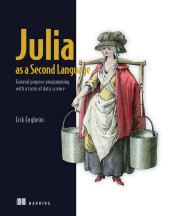
Julia as a Second Language
An integer is a whole number with no fractional component, including positive, negative, and zero values.
- How it is used
- Introduces integers through calculator-style Julia operations and practical numeric type choices.
- How deep it goes
- Explains fixed-width types, ranges, overflow, division, and rounding, while directing unfamiliar readers to background on number types and overflow.
- Examples
- Uses Int8 range checks, an out-of-range UInt8 conversion, quotient and remainder calculations, and rounding to an integer type.
- What you can do after
- Apply it via Julia to select integer types, inspect their ranges, and calculate integer quotients and remainders.

Clojure: The Essential Reference
The int type is a fixed-width signed integer type representing whole-number values in the Java numeric type system.
- How it is used
- Deploys fixed-width integer arithmetic for hashing, image processing, coordinates, and other algorithms requiring int behavior.
- How deep it goes
- Defines 32-bit bounds, two’s-complement rollover, operator arities, casting, return types, and worked algorithmic uses.
- Examples
- Demonstrates typed addition, boundary rollover, line drawing, pixel coordinates, and Java int-array painting.
- What you can do after
- Apply unchecked-*-int operators to implement fixed-width arithmetic and integer-based algorithms with explicit overflow behavior.
Read how Clojure: The Essential Reference explains integer →

The Well-Grounded Rubyist, Fourth Edition
Integer is Ruby's built-in class for representing whole-number values.
- How it is used
- Represents single whole-number values and supports arithmetic within Ruby’s scalar-object model.
- How deep it goes
- Explains object membership, arithmetic behavior, numeric bases, conversion, and operator methods through evaluated examples.
- Examples
- Uses arithmetic tables, hexadecimal and octal literals, base conversions, ASCII conversion, and a temperature converter.
- What you can do after
- Evaluate whole-number expressions, choose integer or floating-point division, and write simple integer-based Ruby programs.
Read how The Well-Grounded Rubyist, Fourth Edition explains integer →
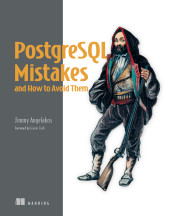
PostgreSQL Mistakes and How to Avoid Them
An integer data type represents whole-number values without a fractional component.
- How it is used
- Uses integers for whole-number data while warning that arithmetic and migration mappings can silently produce incorrect results.
- How deep it goes
- Explains truncating division, implicit casting, zero-divisor safeguards, and cross-database mapping consequences.
- Examples
- Demonstrates order percentages, pg_typeof(), explicit casts, division-by-zero queries, NULLIF, and COALESCE.
- What you can do after
- Diagnose integer arithmetic with pg_typeof(), cast operands, calculate fractional results, and prevent division-by-zero failures.
Read how PostgreSQL Mistakes and How to Avoid Them explains integer →
Also covered in
- Geometry for Programmers
- A Pythonic Adventure: From Python basics to a working web app
- Pandas Workout: 200 exercises to make you a stronger data analyst
- Grokking Relational Database Design
- F# in Action: A Revised Edition of Get Programming with F#
- Statistics Slam Dunk
- Learn SQL in a Month of Lunches
- Fast Python: High performance techniques for large datasets
- Tiny Python Projects: Learn coding and testing with puzzles and games
- ScyllaDB in Action
- 100 SQL Server Mistakes and How to Avoid Them
- Graph Algorithms for Data Science
What to know first
- stringA string is a programming-language value representing textual data as an ordered sequence of characters or encoded units.
- PythonPython is a high-level, general-purpose, dynamically typed programming language with readable syntax and support for multiple programming paradigms.
- functionA function is a callable unit of program code that performs a computation or operation, can accept inputs, and may produce a result or side effect.
- bindingName binding is the association of an identifier with the program entity or value it denotes.
Related concepts
- number typekind of · A numeric type is a type whose values represent numbers with a defined representation and support numerical operations.
- data conversionused by · Data conversion is the transformation of a value or data from one type, format, or representation to another, explicitly or implicitly.
- int32includes · An int32 is a 32-bit integer type or value, conventionally interpreted as a signed integer in programming languages that define signedness.
- byte typecontrasts with · A byte type is a fixed-width integer type occupying eight bits, with signedness and numeric range determined by the language.
- atomic typeuses · An atomic type is a type whose supported accesses and operations are indivisible with respect to concurrent execution and provide defined synchronization semantics.
- longcontrasts with · A long is a language-designated integer type whose precision, range, and representation are defined by the language or implementation.
Questions about integer
What is integer?
An integer is a whole-number mathematical value, including negative numbers, zero, and positive numbers, with no fractional part.
Which Manning books explain integer?
Python Workout, Second Edition, Python Workout: 50 ten-minute exercises, Modern C, Third Edition, Get Programming: Learn to code with Python, Modern C, Learn Rust in a Month of Lunches, Go in Action, Second Edition, Learn PowerShell in a Month of Lunches: Fourth Edition, Covers Windows, Linux, and macOS and 7 more.
What should I know before learning integer?
Manning books that teach integer usually introduce string, Python, function and binding first.
What is the difference between integer and byte type?
An integer is a whole-number mathematical value, including negative numbers, zero, and positive numbers, with no fractional part. A byte type is a fixed-width integer type occupying eight bits, with signedness and numeric range determined by the language.
What kinds of integer are there?
Kinds of integer include int32.
What is integer a kind of?
Integer is a kind of number type. A numeric type is a type whose values represent numbers with a defined representation and support numerical operations.
These guides are generated from the text of Manning books by Manning's knowledge graph and link to the sections they draw on. The full books are available on liveBook and at manning.com.