Byte type
A byte type is a fixed-width integer type occupying eight bits, with signedness and numeric range determined by the language.
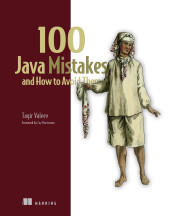
100 Java Mistakes and How to Avoid Them
The byte type is Java's signed 8-bit integer primitive type, representing values from -128 through 127.
- How it is used
- Explains how Java byte values behave in numeric expressions, bitwise composition, shifts, and compound assignments.
- How deep it goes
- Traces sign extension and implicit narrowing through focused failure cases, then stops short of a complete byte-manipulation implementation.
- Examples
- Uses two-byte reconstruction, negative-byte conversion, unsigned right shift, masks, and Byte.toUnsignedInt.
- What you can do after
- Diagnose/debug with it by spotting sign extension, ineffective narrowing, and incomplete static-analysis coverage in byte expressions.
Read how 100 Java Mistakes and How to Avoid Them explains byte type →

Go in Action, Second Edition
A byte is an eight-bit unsigned integer value used in Go to represent raw binary data.
- How it is used
- Represents raw binary data and communicates byte-oriented intent through values such as []byte.
- How deep it goes
- Defines byte as uint8 and demonstrates []byte file handling, but defers broader string and Unicode treatment.
- Examples
- Uses os.ReadFile output, string conversion, strings.Fields, and bytes.Fields to process file contents.
- What you can do after
- Apply it via os.ReadFile and bytes APIs, converting []byte to string when the data is known to be text.
Also covered in
- High Performance Unity Game DevelopmentIn early access (MEAP)
What to know first
- integerAn integer is a whole-number mathematical value, including negative numbers, zero, and positive numbers, with no fractional part.
Related concepts
- integercontrasts with · An integer is a whole-number mathematical value, including negative numbers, zero, and positive numbers, with no fractional part.
- primitive typekind of · A primitive type is a predefined basic data type representing a simple value rather than a composite structure of multiple values or fields.
- data typekind of · A data type classifies values by their permitted forms or representations and the operations or interpretations applicable to them.
- runecontrasts with · A rune is Go’s predeclared alias for int32 that represents a Unicode code point.
Questions about byte type
What is byte type?
A byte type is a fixed-width integer type occupying eight bits, with signedness and numeric range determined by the language.
Which Manning books explain byte type?
100 Java Mistakes and How to Avoid Them and Go in Action, Second Edition.
What should I know before learning byte type?
Manning books that teach byte type usually introduce integer first.
What is the difference between byte type and integer?
A byte type is a fixed-width integer type occupying eight bits, with signedness and numeric range determined by the language. An integer is a whole-number mathematical value, including negative numbers, zero, and positive numbers, with no fractional part.
What is byte type a kind of?
Byte type is a kind of primitive type. A primitive type is a predefined basic data type representing a simple value rather than a composite structure of multiple values or fields.
These guides are generated from the text of Manning books by Manning's knowledge graph and link to the sections they draw on. The full books are available on liveBook and at manning.com.