A pattern language is a collection of related patterns that solve problems within a domain. Each pattern describes a reusable solution to a recurring problem in a particular context. section 7.6.1
Patterns can address problems at different scales, from locating a city to designing a room. In software, a pattern defines collaborating elements that solve an architecture or design problem. section 7.6.1
Banking overdraft policies
A banking application with varied overdraft limits and fees can use the Strategy pattern: an Overdraft interface, concrete strategies, and an Account that uses them. section 7.6.1
Figure 7.11 The visual representation of different types of relationships between the patterns: a successor pattern solves a problem created by applying the predecessor pattern; two or more patterns can be alternative solutions to the same problem; one pattern can be a specialization of another pattern; and patterns that solve problems in the same area can be grouped, or generalized.
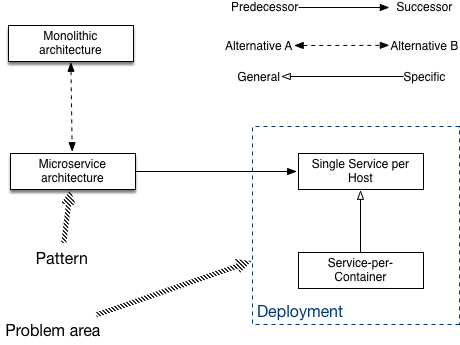
Use the diagram to distinguish successor patterns, alternatives, specializations, and patterns grouped or generalized within the same area. section 7.6.1

