liveBook · Manning

Channel

As explained in Grokking AI Algorithms, Second Edition

A feature channel is one parallel plane of activations or values in a neural-network representation or multidimensional image tensor.

A channel is one parallel plane of values in an image or neural-network representation. A grayscale image has one channel; an RGB image has separate red, green, and blue channels stacked together. section 12.8 section 12.14

Channels keep different kinds of information separate while preserving the same pixel layout. Each RGB channel can be normalized independently, and CNN layers can combine multiple input channels into new feature maps. section 12.8 section 12.17

An RGB pixel across channels

Suppose one pixel has red 100, green 150, and blue 250. Its three channel values normalize to approximately -0.22, 0.18, and 0.96. Repeating this for every pixel produces three normalized matrices. section 12.8

Channel counts describe what a tensor contains:

  • An 8×8 grayscale image is represented with one channel. section 12.14
  • An 8×8 color image is represented with three channels: red, green, and blue. section 12.14
  • A PNG image with transparency can use a fourth alpha channel. section 12.14
  • A later convolution can process eight input channels together, summing their separate convolution results into each output value. section 12.17
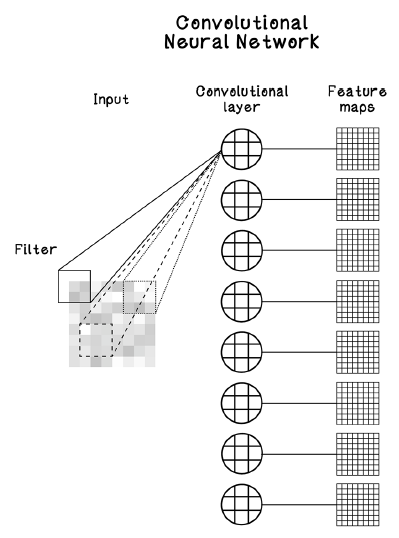
Figure 12.26 Feature maps produced by a convolutional layer
12_26

Visualizes how convolutional layers produce multiple feature maps, making channels concrete as parallel learned representations. section 12.14


How Grokking AI Algorithms, Second Edition covers it

How deep it goes
Explains channel counts, normalization, tensor shapes, and multi-channel convolution, stopping short of formal tensor-layout conventions.
Examples
Uses grayscale matrices, RGB matrices, an alpha channel, normalized pixel values, and eight-channel downsampling examples.
What it assumes
Assumes basic familiarity with pixels and matrices while introducing grayscale, RGB, tensors, feature maps, and convolutional channels.
What you can do after
Evaluate channel dimensions and trace how convolution combines multiple input channels into feature-map values.
How it connects
Connects channels with RGB, tensors, feature maps, convolutional layers, filters, normalization, and alpha transparency.

Also explained in

Compare how 7 books explain channel →

Related concepts

This explainer was generated by Manning's knowledge graph from the text of Grokking AI Algorithms, Second Edition. The section links point to the parts of the book it draws on.




