A convolution channel is an independent stream of features processed alongside other streams by a convolutional layer. In text CNNs, each word-embedding dimension becomes a channel, allowing a filter to detect patterns across token positions and embedding features simultaneously. section 7.4.2 section 7.2.6
Use channels to keep feature dimensions aligned while convolution moves through a sequence:
- Represent a sequence with one row per feature channel and one column per token position. section 7.2.6
- Transpose embedding outputs before a 1D convolution so convolution advances across words rather than embedding dimensions. section 7.4.2
- Set in_channels to the embedding size or other feature count; set out_channels to the number of learned pattern detectors. section 7.5.1
- Track channel counts and matrix shapes because increasing channels expands outputs and can increase overfitting. section 7.5.1
Four channels matching a phrase pattern
Encode each token with four binary POS channels: ADV, ADJ, VERB, and NOUN. A three-token kernel is therefore a 4 × 3 matrix. Loading it into Conv1d with in_channels=4 lets the filter respond to the encoded pattern across the sequence, producing a value of 3.0 where the intended phrase appears. section 7.2.6
Figure 7.16 Word embeddings for convolution
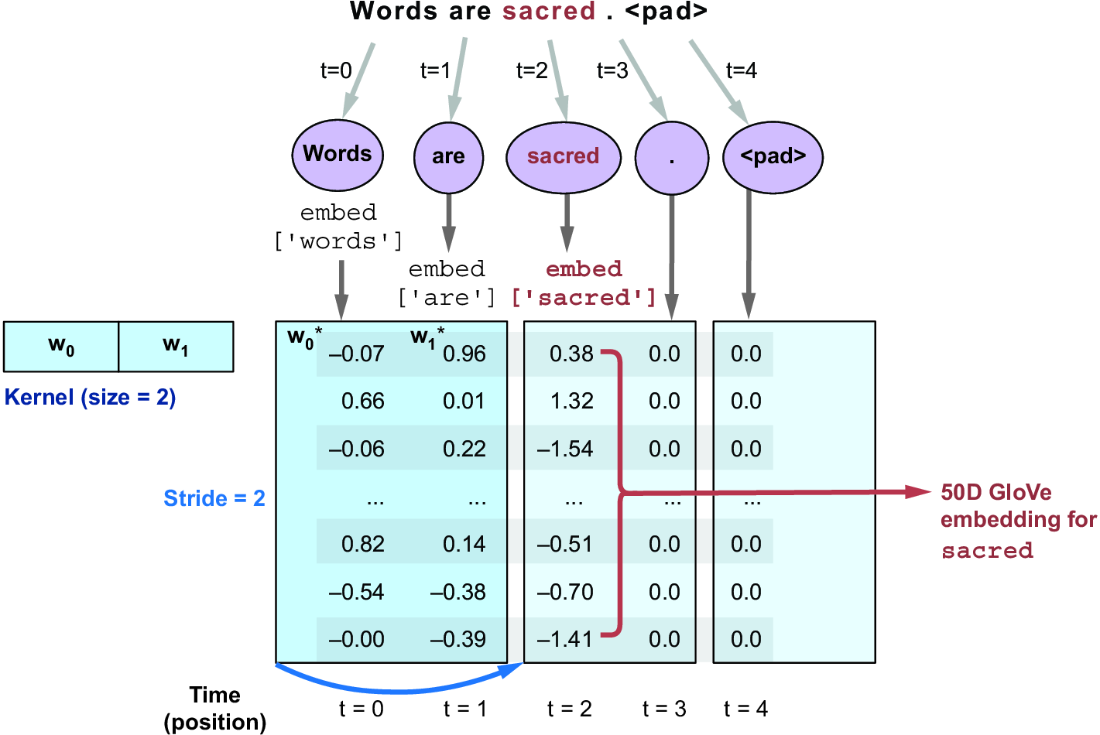
Visualizes how word-embedding dimensions line up as convolution channels while a 1D kernel moves across the word sequence. section 7.4.2






