An activation function applies a nonlinear transformation to aggregated, transformed messages in a neural network layer. In graph message passing, it helps prevent stacked layers from collapsing into an overall linear model. section 3.4.2
A message-passing layer uses the activation function in this sequence:
- Aggregate node or edge information with an order-independent operator such as sum, average, or maximum. section 3.4.2
- Transform the aggregated messages with a neural network and activation function. section 3.4.2
- Combine the resulting embeddings with node or edge data and previous embeddings; apply pooling only when graph-level output requires it. section 3.4.2
ReLU
ReLU returns the maximum of zero and its input. Applied after message aggregation and transformation, it supplies the nonlinearity needed for a graph convolutional layer to model more than a linear relationship. section 3.4.2
Figure 3.15 Elements of our message-passing layer. Each message-passing layer consists of an aggregation, a transformation, and an update step.
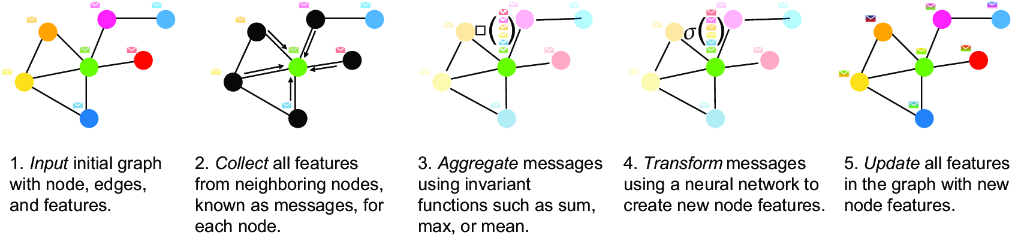
Use the layer diagram to trace aggregation, transformation, and update operations around the activation function. section 3.4.2













