liveBook · Manning

Activation function

As explained in Machine Learning Algorithms in Depth

An activation function is a nonlinear function applied to a neural-network layer output to increase the model's expressive capacity.

An activation function applies a nonlinearity between neural-network layers, allowing stacked affine transformations to represent more expressive functions than a purely linear network. section 10.1

Choose the activation according to the layer's role and prediction task:

  • Use ReLU as a common hidden-layer nonlinearity in a multilayer perceptron. section 10.1
  • Use softmax at a classification output to convert real-valued inputs into class probabilities summing to one. section 10.1
  • Use the identity function at a regression output. section 10.1
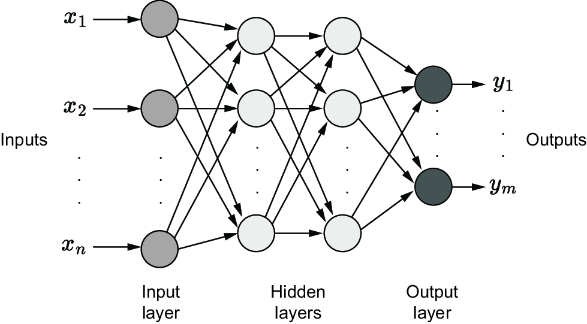
Figure 10.1 MLP architecture
figure

Use the MLP architecture figure to locate activation functions between affine layers and distinguish hidden-layer and output-layer roles. section 10.1


How Machine Learning Algorithms in Depth covers it

How deep it goes
Defines ReLU and identifies softmax and identity by output task, but defers detailed activation derivatives and comparisons.
Examples
Uses ReLU in hidden layers, softmax for classification, identity for regression, and an MLP architecture as concrete examples.
What you can do after
Evaluate activation choices for hidden layers and classification or regression output layers.
How it connects
Connects activation functions to multilayer perceptrons, affine transformations, softmax, classification, regression, loss functions, and backpropagation.

Also explained in

Compare how 14 books explain activation function →

Related concepts

This explainer was generated by Manning's knowledge graph from the text of Machine Learning Algorithms in Depth. The section links point to the parts of the book it draws on.










