An active router is the router in a first hop redundancy protocol (FHRP) group that currently forwards traffic for a shared default gateway. Hosts use the group’s virtual IP address (VIP), while the active router forwards frames addressed to the shared virtual MAC address. section 19.1.2 section 19.4
Understand the active router’s operational behavior:
- Wins an election against standby routers through FHRP hello messages; in HSRP, the highest priority wins, followed by the highest IP address. section 19.1.2 section 19.3
- Answers host ARP requests for the VIP with the virtual MAC, so hosts retain a stable default-gateway mapping. section 19.1.2
- Triggers failover when it fails; the standby router becomes active and sends gratuitous ARP (GARP) messages so switches relearn the virtual MAC’s port. section 19.1.3 section 19.4
- May reclaim the active role after recovery only when preemption is enabled; HSRP disables preemption by default. section 19.2.1 section 19.1.3
HSRP election example
R1 and R2 share VIP 10.0.0.1. R1 uses priority 105 and R2 uses the default priority 100, so R1 becomes active and R2 remains standby. The command show standby brief confirms R1’s Active state and identifies R2 as standby. section 19.3
Figure 19.4 An FHRP failover. (1) A hardware failure occurs on R1. (2) R2 takes over as the active router. (3) R2 sends GARP messages, sourced from the virtual MAC and destined for the broadcast MAC. (4) The switches learn the virtual MAC on the appropriate ports—those leading toward the new active router. (5) End hosts’ default gateways and ARP table entries for the VIP remain the same.
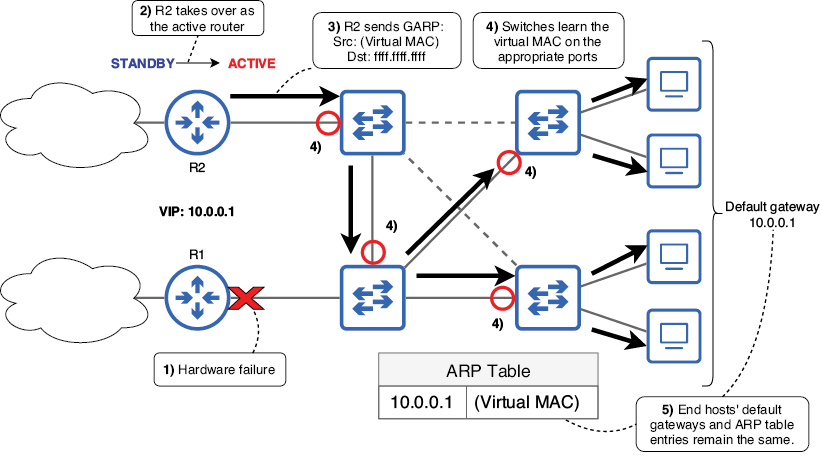
Follow the failover sequence from hardware failure through standby takeover, GARP transmission, switch relearning, and unchanged host gateway settings. section 19.1.3
