liveBook · Manning

Active virtual forwarder

As explained in Acing the CCNA Exam: Volume 1 Fundamentals and Protocols

An active virtual forwarder is a GLBP router role associated with a unique virtual MAC address that forwards traffic for the shared gateway.

An active virtual forwarder (AVF) is a GLBP router role that actively forwards traffic for a shared gateway. Each AVF receives a unique virtual MAC address, allowing multiple routers to serve hosts in one subnet. section 19.2.3

GLBP elects an Active Virtual Gateway (AVG), which assigns up to four AVFs. The AVG answers ARP requests with an AVF’s virtual MAC address in round-robin order, distributing hosts across the forwarders while they use one virtual IP address. section 19.2.3

Two-router GLBP LAN

In a 10.0.0.0/24 LAN, R1 and R2 can act as AVFs. The AVG returns R1’s virtual MAC to some hosts and R2’s to others, so traffic is load-balanced within the same subnet. AVF 1 in group 1 uses 0007.b400.0101. section 19.2.3

Figure 19.6 GLBP enables load balancing among hosts in the same subnet. Half of the hosts in 10.0.0.0/24 use one AVF (R1) as their default gateway, and the other half use the other AVF (R2). Each AVF has a unique virtual MAC address.
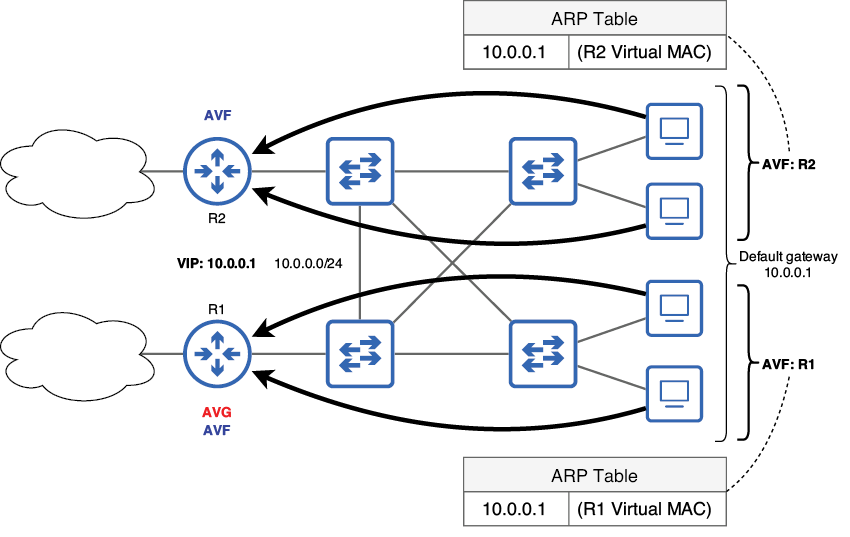
Use the figure to visualize how one virtual IP and multiple AVF virtual MAC addresses distribute hosts across routers. section 19.2.3

How Acing the CCNA Exam: Volume 1 Fundamentals and Protocols covers it

How deep it goes
Explains AVF assignment, ARP-based virtual MAC selection, addressing format, and default preemption behavior.
Examples
Uses a two-router 10.0.0.0/24 scenario and the 0007.b400.0101 virtual MAC example.
What it assumes
Assumes familiarity with default gateways, ARP, virtual IP addresses, and first-hop redundancy protocols.
What you can do after
Evaluate GLBP designs that distribute hosts across up to four active virtual forwarders.
How it connects
Connects active virtual forwarders with GLBP, Active Virtual Gateway, ARP, virtual MAC addresses, and round-robin distribution.

Related concepts

This explainer was generated by Manning's knowledge graph from the text of Acing the CCNA Exam: Volume 1 Fundamentals and Protocols. The section links point to the parts of the book it draws on.