An active virtual gateway is the GLBP router that answers ARP requests for the virtual gateway and assigns active virtual forwarders (AVFs). section 19.2.3
The AVG matters because it coordinates GLBP load balancing:
- Assigns up to four AVFs, including itself when eligible. section 19.2.3
- Answers ARP requests with an AVF’s virtual MAC address rather than its own. section 19.2.3
- Uses round-robin replies so different hosts in one subnet use different forwarders. section 19.2.3
- Keeps AVG preemption disabled by default, while AVF preemption is enabled by default. section 19.4
Two-router GLBP subnet
R1 becomes the AVG and an AVF, while R2 becomes another AVF. With one virtual IP address, 10.0.0.1, the AVG returns each AVF’s unique virtual MAC in turn, causing different hosts to use R1 or R2. section 19.2.3
Figure 19.6 GLBP enables load balancing among hosts in the same subnet. Half of the hosts in 10.0.0.0/24 use one AVF (R1) as their default gateway, and the other half use the other AVF (R2). Each AVF has a unique virtual MAC address.
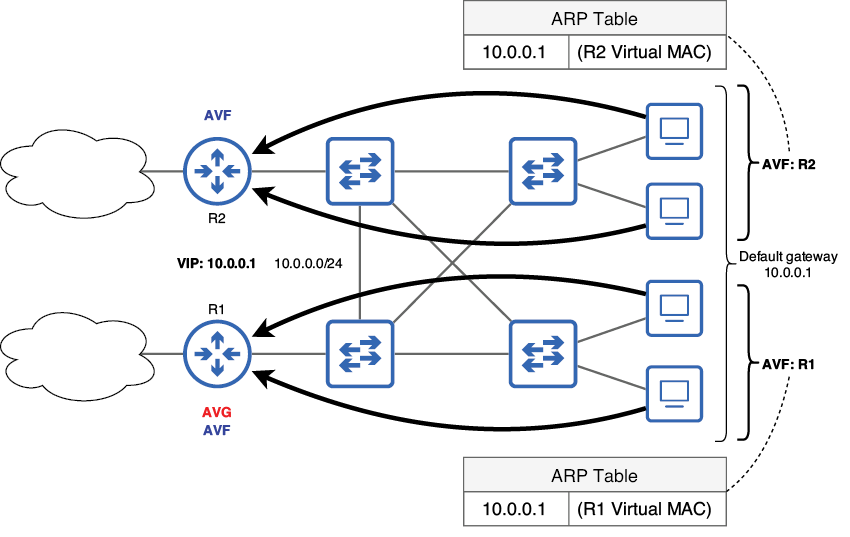
View the GLBP topology showing the AVG, AVFs, virtual IP address, and per-host forwarding distribution. section 19.2.3
