An actor is any person, external system, or other agent that interacts with an application in a use case. Actors remain outside the application boundary. section 3.7.1
Actors clarify who or what participates in application behavior:
- A person, such as a librarian or customer. section 3.7.1
- Another application or system, such as a database system. section 3.7.1
- An interaction line connects an actor to the use cases it can perform. section 3.7.1
Searching a catalogue
In the “Search Catalogue” use case, the customer is the triggering actor. The customer submits target book attributes, and the catalogue returns matching books. The description records the actor’s goal, trigger, action steps, alternate sequences, and postconditions. section 3.7.2
Figure 3.4 A UML use case diagram containing the names of six use cases for an advanced version of our book catalogue application. The labels in the dashed boxes and the dashed arrows indicate the various components of the diagram. When drawing a use case diagram, do not include these labels and arrows.
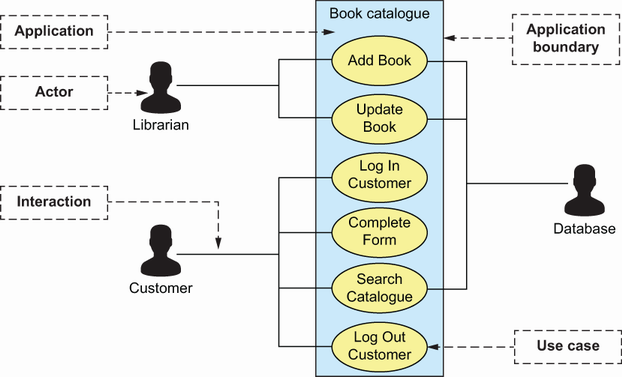
Use the UML diagram to see actors positioned outside the application boundary and connected to the use cases they interact with. section 3.7.1






