An actor is any person, system, or other external agent that interacts with an application through a use case. The application boundary separates actors from the functionality they access. section 3.6.1
Use actors to clarify who or what participates in an application’s behavior:
- Represent people such as a librarian or customer. section 3.6.1
- Represent external applications or systems, such as a database system. section 3.6.1
- Connect each actor to the use cases it can interact with. section 3.6.1
- Describe each use case from the viewpoint of the actor that triggers it, including goals, actions, alternatives, and outcomes. section 3.6.2
Book catalogue search
For a Search Catalogue use case, the customer triggers the search by submitting target book attributes; the catalogue returns matching books. section 3.6.2
Figure 3.4 A UML use case diagram containing the names of six use cases for an advanced version of our book catalogue application. The labels in the dashed boxes and the dashed arrows indicate the various components of the diagram. When drawing a use case diagram, do not include these labels and arrows.
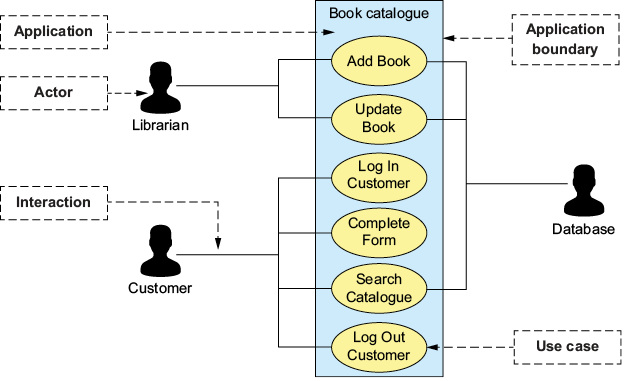
Inspect the use case diagram to see actors, application boundaries, use cases, and interaction lines together. section 3.6.1






